
Buying Land (Tochi) in Japan as a Foreigner

Can foreigners buy land in Japan? Yes — with no restrictions on residential tochi. Learn the complete process, costs, taxes, zoning rules, and financing options for foreign land buyers.
Buying Land (Tochi) in Japan as a Foreigner: The Complete Guide
Purchasing land — known as tochi (土地) — in Japan is one of the most exciting paths for foreigners who want to build their dream home, start a rural retreat, or invest in Japanese real estate. The good news: Japan places no legal barriers on foreign land ownership. Whether you are a resident expat, a non-resident investor, or somewhere in between, you have the same right to buy land as a Japanese citizen.
This comprehensive guide walks you through everything you need to know: legal rights, land categories, step-by-step process, costs, financing options, and the key pitfalls to avoid.
Can Foreigners Buy Land in Japan? Legal Rights Explained
Japan is one of the most open countries in Asia when it comes to foreign property and land ownership. There is no requirement for residency, permanent residency, or Japanese citizenship to purchase land. The Foreign Exchange and Foreign Trade Act (FEFTA) governs international transactions, but it does not prohibit foreigners from owning residential land.
Key points on your legal rights:
- You can own land freehold (not leasehold) — full ownership, just like a Japanese citizen
- No special visa is required to purchase land
- Buying land does not grant you a visa or residency status
- Non-residents must report the purchase to the Bank of Japan within 20 days of the transaction
However, there are two important restrictions:
- Sensitive area land: Land near Self-Defense Force bases, nuclear facilities, border islands, or coastal strategic zones may require prior government approval under FEFTA. The approval process takes 30–60 days.
- Agricultural and forest land: You cannot simply purchase farmland (nochi) or forest land without special permission. Agricultural land requires proof of farming intent and approval from the local agricultural committee.
For most foreigners looking to build a home or make a residential investment, neither restriction will apply. Stick to residential land (jutakuchi/住宅地) and you will have a smooth path forward.
For more on your legal rights as a foreign property buyer, see our guide: Can Foreigners Buy Property in Japan? Legal Rights and Restrictions.
Understanding Japanese Land Categories
Before you buy, understanding how Japan classifies land is essential. Zoning laws (都市計画法, toshi-keikaku-ho) determine what you can build and how much of the plot you can cover.
| Land Category | Japanese Term | Typical Use | Notes |
|---|---|---|---|
| Residential Category 1 | 第一種低層住居専用地域 | Low-rise housing | Floor-area ratio 50–200% |
| Residential Category 2 | 第一種中高層住居専用地域 | Mid/high-rise housing | Floor-area ratio up to 400% |
| Commercial Zone | 商業地域 | Mixed-use, retail | Higher density allowed |
| Agricultural Land | 農地 | Farming only | Special permit required |
| Forest Land | 森林 | Forestry | Prefectural approval needed |
| Urbanization Control Zone | 市街化調整区域 | Development restricted | Very difficult to build |
Key metric: Building Coverage Ratio (建蔽率, kenpei-ritsu) This defines what percentage of your plot can be covered by a building footprint — typically 30–80% depending on the zone.
Key metric: Floor-Area Ratio (容積率, yoseki-ritsu) This defines total floor area as a percentage of land area — critical for calculating how large your home can be.
Always verify zoning with your real estate agent or the local municipal office before signing anything.
Step-by-Step Process for Buying Land in Japan
Buying land in Japan follows a structured legal process. Here is the typical flow from search to ownership:
Step 1: Define Your Requirements and Budget
Determine your intended use (home build, investment, agriculture), preferred region, plot size, and total budget including all fees. Account for 7–10% over the land purchase price for transaction costs alone.
Step 2: Engage a Bilingual Real Estate Agent
Using an agent experienced with foreign buyers is essential. They will handle the explanation of the Explanation of Important Matters (重要事項説明書, juyo jiko setsumeisho) — the legal disclosure document required before any contract is signed. This must be explained orally and, ideally, in your language.
See our full walkthrough: Step-by-Step Home Buying Process in Japan for Foreigners.
Step 3: Conduct Due Diligence
Before committing to any land purchase:
- Verify zoning and land use at the local municipal office
- Check disaster risk — flood maps, landslide risk, and earthquake liquefaction risk are publicly available
- Confirm road access — you need a road of at least 4 meters width adjacent to the plot to obtain a building permit
- Soil test — especially for older plots or rural areas; contaminated land is a real risk
- Utility connections — water, sewage, gas, and electricity may not already be connected in rural areas
Step 4: Sign the Sales Agreement and Pay Deposit
Once you agree on terms, you sign the Purchase Agreement (売買契約, baibai keiyaku). At this point, you pay a deposit (手付金, tetsukekin) — typically 5–10% of the purchase price. This deposit is generally non-refundable if you withdraw.
Step 5: Final Payment and Ownership Transfer
On the settlement date, you pay the remaining balance and the property is transferred. A judicial scrivener (司法書士, shihoshoshi) handles the registration of ownership in the Japanese land registry on your behalf.
Step 6: Register Your Ownership
Ownership is officially recorded in the Real Estate Registry (不動産登記, fudosan toki). From fiscal year 2026, Japan plans to require foreign buyers to declare their nationality in this registry — a transparency measure, not a restriction.
After purchase, if you are a non-resident, you must appoint a Japanese tax representative (納税管理人) to handle your tax obligations.
Land Prices in Japan: What to Expect
Land prices vary enormously by location. Here is a realistic breakdown:
| Location | Price per ㎡ (Approx.) | Typical Plot (100㎡) |
|---|---|---|
| Tokyo Central (Minato, Shibuya) | ¥800,000 – ¥1,200,000 | ¥80M – ¥120M |
| Tokyo Suburbs (30–40 min commute) | ¥200,000 – ¥400,000 | ¥20M – ¥40M |
| Osaka Central | ¥400,000 – ¥600,000 | ¥40M – ¥60M |
| Regional Cities (Sapporo, Fukuoka) | ¥50,000 – ¥150,000 | ¥5M – ¥15M |
| Rural Areas / Countryside | ¥10,000 – ¥50,000 | ¥1M – ¥5M |
Note: These are general ranges for residential land. Prices in areas with high demand, good schools, or proximity to transport hubs will be at the higher end. For investment ideas in regional Japan, see our guide: Rural and Countryside Properties in Japan for Foreign Buyers.
All the Costs of Buying Land in Japan
Understanding the true cost of a land purchase prevents nasty surprises. Here is a complete cost breakdown:
| Cost Item | Rate / Amount |
|---|---|
| Real estate agent commission | ~3% of purchase price + ¥60,000 + consumption tax |
| Stamp duty (印紙税) | ¥5,000 – ¥60,000 (based on contract value) |
| Registration tax (登録免許税) | 1.5% of assessed land value (reduced rate) |
| Judicial scrivener fee | ¥150,000 – ¥300,000 |
| Real estate acquisition tax | 1.5–3% of assessed value (paid ~6 months after purchase) |
| Annual fixed asset tax (固定資産税) | ~1.4% of assessed value per year |
| Annual city planning tax (都市計画税) | Up to 0.3% of assessed value per year |
Rule of thumb: Budget an additional 7–10% of the land purchase price for transaction costs. Our detailed breakdown is here: Hidden Costs and Fees When Buying Property in Japan.
For more on ongoing ownership costs, see: Property Taxes and Annual Costs of Owning Property in Japan.
Financing Land Purchases in Japan as a Foreigner
Land-only financing is more difficult than property loans because there is no existing structure as collateral. Most Japanese banks will not offer a standalone land loan to a non-resident. Financing typically works as follows:
If you have Permanent Residency (PR): You have access to most Japanese banks with a down payment of 10–20%. Interest rates are generally 0.5–2% depending on the loan structure. Banks like SMBC Prestia, Shinsei Bank, and SBI Shinsei are known to work with foreign residents.
If you are a long-term resident without PR: Down payment requirements rise to 30% or more. Some banks (Aeon Bank, Suruga Bank, Tokyo Star Bank) will lend with 2+ years of stable employment history.
If you are a non-resident: Land loans from Japanese banks are extremely rare. Your options are:
- Cash purchase (most common for non-resident foreign buyers)
- Home country bank loan using overseas assets as collateral
- Private lender or developer financing
For a comprehensive guide to financing options, see: Mortgages and Home Loans for Foreigners in Japan.
For detailed information on mortgage applications and required documents, Gaijin Buy House has an excellent breakdown of what foreigners need to submit.
Building on Your Land: What You Need to Know
Buying land is only step one — if you plan to build a home, there are additional requirements:
- Building permit (建築確認, kenchiku kakunin): Required before construction. Your plot must be adjacent to a road of at least 4 meters.
- Building coverage ratio: Limits the footprint of your building (typically 40–60% for residential zones).
- Setback rules: Many zones require buildings to be set back from property boundaries.
- Construction costs: Budget ¥150,000–¥300,000 per square meter for a mid-range home build.
If you want to buy both land and build a home, consider working with a house and land package (建売住宅) developer who handles planning and construction.
For an overview of all property types available in Japan, see: Types of Properties Available in Japan: A Complete Guide.
Tax Implications for Foreign Land Owners
Japan treats foreign landowners the same as domestic owners for most taxes. The key obligations are:
- Fixed asset tax: ~1.4% of assessed value annually, billed April/May each year
- City planning tax: Up to 0.3% for land in designated urban planning zones
- Capital gains tax on sale: 20.42% for non-residents (withholding tax system)
- Inheritance: Japanese inheritance law applies to land in Japan, regardless of your nationality
Non-resident requirement: If you live outside Japan, you must appoint a tax representative (納税管理人) — a Japanese resident who will receive tax notices and make payments on your behalf. This is a legal requirement, not optional.
For more information on legal procedures and documentation, see: Legal Procedures and Documentation for Japan Property Purchase.
For the full picture on property taxes, Housing Japan provides a regularly updated breakdown of Japan property taxes.
Tips for a Smooth Land Purchase
- Work with a bilingual agent or bilingual judicial scrivener — misunderstanding zoning or legal terms can be costly.
- Check the land's history — some older urban plots have contaminated soil from previous industrial use.
- Verify road access carefully — land without legal road access cannot receive a building permit.
- Be patient with FEFTA-sensitive areas — if your target land is in a restricted zone, factor in 1–2 months for approval.
- Consider rural akiya land — some municipalities offer subsidized or near-free land in depopulating rural areas. See our guide: Akiya (Vacant and Abandoned Houses) in Japan for Foreigners.
- Research land prices by region — use tools like Tokyo Portfolio's Japan property market guide to understand pricing trends before committing.
For broader guidance on the Japan buying journey, Living in Nihon's comprehensive property and mortgage guide for foreigners covers many related topics in detail.
You can also find useful resources and support at For Work in Japan, which covers living and working in Japan as a foreigner, including navigating real estate decisions.
For the complete overview of everything involved in buying property in Japan, see: Complete Guide to Buying Property in Japan as a Foreigner.
Conclusion
Buying land in Japan as a foreigner is entirely achievable. Japan's open land ownership laws mean you face no legal barriers to purchasing residential tochi — you simply need to understand the process, budget accurately for all costs, and work with experienced professionals.
The most important steps: verify zoning, confirm road access, understand your financing options, and appoint a tax representative if you are a non-resident. Done right, owning land in Japan can be the foundation of a beautiful home, a smart investment, or your personal escape from city life.
Ready to start? Begin with our Complete Guide to Buying Property in Japan for the full picture, then use this guide to navigate the specific challenges of land purchases in Japan.

Originally from Vietnam, living in Japan for 16+ years. Graduated from Nagoya University, with 11 years of professional experience at Japanese and international companies. Sharing information about buying property in Japan for foreigners.
View Profile →Related Articles
Japan Property Grading: How Mansions and Buildings Are Evaluated
Understand Japan's property grading systems including seismic resistance grades (1-3), Housing Performance Indication (10 indicators), CASBEE, BELS, and building structure types RC/SRC — essential knowledge for foreign buyers of mansions and houses.
Read more →
Japan Building Age Categories: New Build vs Used Property Standards
Understand Japan's building age categories — kyu-taishin, shin-taishin, post-2000, and new build standards. Essential guide for foreigners buying property in Japan, covering seismic standards, depreciation, and what to check before buying.
Read more →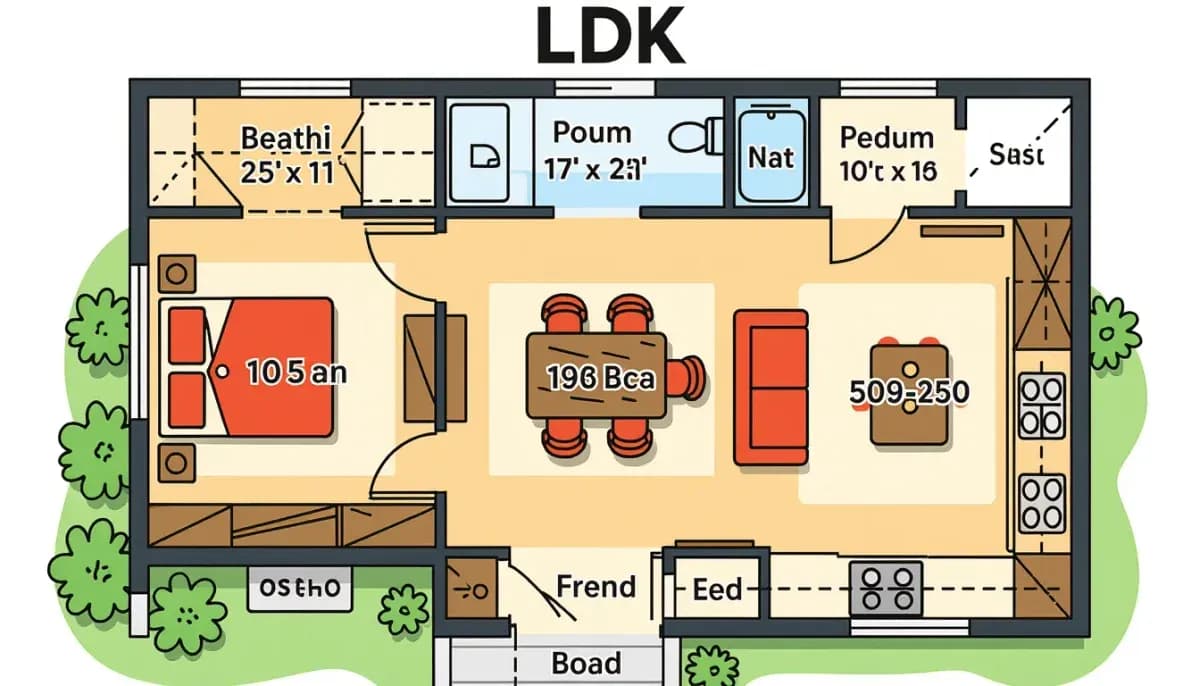
How to Read Japan Property Floor Plans: A Visual Guide
Learn to read Japanese property floor plans with confidence. Understand LDK notation, tatami measurements, floor plan symbols, and common room labels used in Japan real estate listings.
Read more →
Japan Mixed-Use Properties: Residential and Commercial Combined
Complete guide to buying mixed-use residential and commercial property in Japan as a foreigner. Covers zoning laws, financing, investment returns, and the step-by-step buying process.
Read more →
Japan Garage Houses: Properties for Car Enthusiasts
Everything foreign car enthusiasts need to know about buying a garage house in Japan — built-in garage types, tax benefits, costs, design features, and how foreigners can purchase property with full ownership rights.
Read more →
Japan Penthouse and Luxury Apartment Guide
Complete guide to buying or renting a penthouse or luxury apartment in Japan as a foreigner. Covers prices, locations, legal rules, guarantor requirements, and top buildings in Tokyo and beyond.
Read more →