
Parking and Garage Requirements for Japan Houses

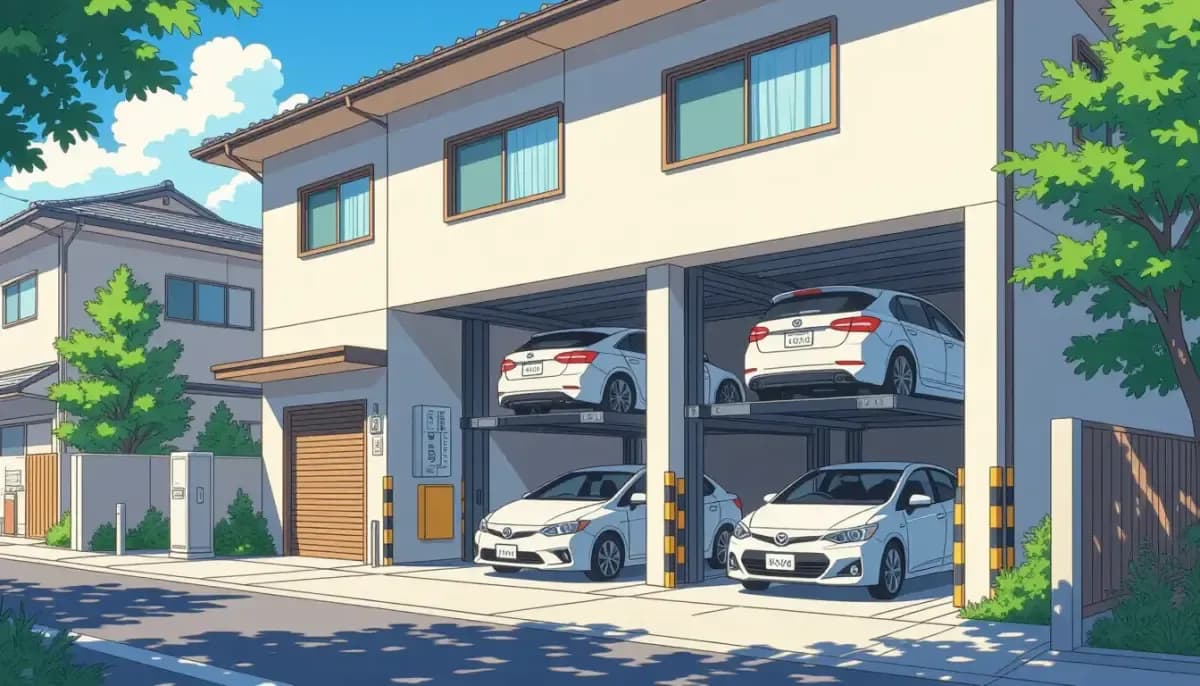
Learn Japan's parking and garage requirements for homeowners. Everything about the Shako Shomeisho certificate, types of residential parking, costs by region, and tips for foreigners buying property in Japan.
Parking and Garage Requirements for Japan Houses: A Complete Guide for Foreigners
Buying a house in Japan comes with an unexpected responsibility that many foreigners overlook: securing dedicated parking. Unlike most Western countries where you simply park on the street, Japan legally requires homeowners and car owners to prove they have a reserved off-street parking space before they can even register a vehicle. Understanding Japan's parking and garage requirements is essential whether you're purchasing a house with an existing garage, renting a monthly parking space, or trying to register a car after your move.
This guide covers everything you need to know about parking requirements in Japan — from the famous Shako Shomeisho (garage certificate) to the different types of residential parking structures, regional cost differences, and step-by-step guidance for foreigners navigating the system.
!Parking and garage requirements at a Japanese residential house with mechanical tower parking system
Japan's Proof-of-Parking Law: Why It Exists
Japan enacted the Garage Act in 1962, and it fundamentally changed how Japanese society relates to car ownership. The law requires every car owner to demonstrate they have a reserved, off-street parking space within 2 kilometers (straight-line) of their home address before they can register a vehicle. Car dealerships will not deliver a vehicle until the buyer presents this certificate, making it impossible to own a car without secured parking.
This policy was born from necessity. Post-war Japan urbanized rapidly, and narrow residential streets became congested with illegally parked vehicles, causing safety hazards and traffic gridlock. The proof-of-parking rule, combined with a strict overnight street parking ban (vehicles in metered lots after 3 AM will be towed), effectively eliminated on-street overnight parking in Japanese cities.
The result: Japan has an extraordinarily orderly parking culture with virtually no abandoned or illegally stored vehicles in residential neighborhoods — a stark contrast to many other countries. For foreigners moving to Japan, this means you cannot simply buy a car and park it in front of your house unless you own or lease a dedicated parking space.
Types of Residential Parking in Japan
Japan offers several residential parking configurations, each with distinct advantages and trade-offs:
1. Ground-Level Flat Lots (平面駐車場)
The simplest form of parking: an open, at-grade space on the property or nearby. Common in suburban and rural areas where land is less expensive. Easy to access, no mechanical components, and accommodating of most vehicle sizes including larger foreign-imported cars. In cities, flat lots are increasingly rare due to high land values.
2. Attached Home Garages (ガレージ)
Many single-family homes (particularly detached houses, ikkodate) are built with an integrated garage or covered carport. These are the most convenient option for homeowners, as the parking space is literally part of the property. When buying a house in Japan, confirm whether the garage space counts toward the building's floor area ratio (FAR) calculation, as this affects tax assessments.
3. Multi-Story Covered Garages (立体駐車場)
Common in condominium buildings and apartment complexes. Vehicles are parked on multiple levels in a concrete structure. These offer weather protection and more spaces per plot of land, but involve longer walks from the parking level to the residence.
4. Mechanical Tower Parking (機械式駐車場)
A uniquely Japanese solution to urban land scarcity: automated underground or above-ground parking towers that store multiple vehicles in vertical stacks. When you pull your car into the entry bay and press a button, the system lifts and rotates your vehicle into a storage compartment. Drivers must fold their side-view mirrors before entering mechanical parking systems — a standard step that catches many foreigners by surprise.
Mechanical systems protect vehicles from weather and maximize space efficiency, but they are slower (retrieval can take 5–10 minutes), have strict vehicle size limits, and carry significant maintenance costs (~¥14,000/month per space). Many older condominium buildings are struggling financially with mechanical parking systems as car ownership rates decline.
5. Monthly Rental Parking (月極駐車場)
If your house or condo does not include parking, you can lease a monthly space (月極, tsukigime) from a parking operator within 2 km of your home. This is the most common solution for urban residents. Look for the sign showing "空" (vacancy available) at parking facilities.
The Shako Shomeisho (車庫証明書): Japan's Garage Certificate
The Shako Shomeisho (車庫証明書, Vehicle Storage Location Certificate) is the cornerstone of Japan's parking system. It is issued by the local police station and certifies that your vehicle has a designated storage location near your home. Without it, you cannot complete vehicle registration.
Who Needs It?
The certificate is required in all major cities and urban areas. Some exemptions exist:
- Rural municipalities may waive the requirement for kei cars (軽自動車) in low-density areas
- Light motorcycles (50cc and under) are generally exempt
- Motorcycles 125cc and above typically require a certificate
For foreigners, the process is identical to that for Japanese citizens, provided you have mid-to-long-term residency status.
Required Documents
| Document | Purpose | Notes |
|---|---|---|
| Automatic Vehicle Storage Location Certification Application | Main application form | Available at police station |
| Storage Location Marker Issuance Application | Sticker application | Submitted simultaneously |
| Location Map (周辺図) | Shows distance from home to parking | Must show ≤ 2 km straight-line |
| Layout Diagram (配置図) | Shows parking space dimensions | Vehicle must fit entirely within |
| Consent Certificate (保管場所使用承諾証明書) | For leased/rented spaces | Must carry lessor's seal/stamp |
| OR Self-Certification of Rights (保管場所使用権原疎明書面) | For owned spaces | Proves ownership |
| Seal Registration Certificate (印鑑証明書) | Identity verification | From municipal office |
Important: Any single error in documents requires resubmitting everything. Double-check all forms before submission.
Application Process
- Secure your parking space — sign a lease or confirm ownership
- Prepare all six documents listed above
- Submit at your local police station (weekdays, 9 AM–5 PM)
- Pay the application fee: ¥2,000–¥3,000 (varies by prefecture)
- Wait for processing: 3–7 business days
- Collect your certificate and present it to the car dealership
Total timeline from parking search to completed vehicle registration: approximately 3–6 weeks.
For detailed instructions specifically for foreigners, see this garage certificate guide for foreigners at ziplus.jp.
Parking Requirements When Buying a House in Japan
When purchasing a property in Japan, parking considerations affect both the buying decision and ongoing costs:
What to Check During Property Search
- Does the property include a parking space? Many house listings include a garage or parking slot; confirm whether it is part of the registered property or a separately leased space.
- Vehicle size compatibility: Japan's roads and garages are designed for compact Japanese cars. If you drive a larger foreign vehicle (SUV, pickup truck), verify the garage dimensions carefully.
- Mechanical parking restrictions: Some condominiums with mechanical parking systems have vehicle height, width, and weight limits. Ground clearance minimums are also common.
- Parking space ratio: New condominiums are no longer required by national law to include parking. Check the ratio — the percentage of units with assigned spaces. In Tokyo, new buildings averaged only 42.2% coverage in 2017, down from 77.3% in 2007.
Building Regulations and Zoning
Japan's Building Standards Law does not universally mandate parking for single-family homes, but local government ordinances often do. Requirements vary by:
- Land use zone (commercial, residential, industrial)
- Building floor area: Mandates only apply from approximately 5,000–6,000 square meters total floor area
- Municipality: Tokyo, Osaka, Nagoya, and other major cities all have distinct parking supply rules
For smaller residential properties, there is generally no legal minimum number of parking spaces — you can buy a house without garage space and simply rent monthly parking within 2 km. However, this adds a recurring monthly cost.
Regional Parking Costs in Japan
Monthly parking costs vary enormously depending on location:
| Region/Area | Monthly Parking Cost (Approx.) |
|---|---|
| Central Tokyo (Minato, Shinjuku, Shibuya) | ¥50,000–¥80,000+ |
| Tokyo 23 Wards (average) | ¥30,000–¥40,000 |
| Condominium building association fee (central Tokyo) | ¥30,000–¥50,000 |
| Osaka, Nagoya city centers | ¥20,000–¥40,000 |
| Mid-sized cities (Sapporo, Fukuoka, Sendai) | ¥8,000–¥20,000 |
| Suburban areas | ¥5,000–¥15,000 |
| Rural areas | ¥3,000–¥8,000 |
| National average (all areas) | ~¥8,300 |
These costs are in addition to any maintenance fees for mechanical parking systems within condominium buildings. Mechanical tower spaces may add ¥5,000–¥15,000/month for maintenance costs on top of the base rental rate.
Practical Tips for Foreigners
Finding Monthly Parking in Japan
Several apps and platforms help you locate available monthly parking near your home:
- akippa — largest parking sharing platform, allows monthly contracts
- Nokisaki — connects property owners with drivers seeking parking
- At Parking and Repark — traditional monthly parking search platforms
- Monthly Parking.com (月極.com) — aggregator of monthly lots
Search for lots displaying the "空" character (meaning "vacancy").
Coin Parking Cannot Be Used for Your Certificate
This is a common mistake: coin-operated hourly parking lots (コインパーキング) cannot be used as your registered parking address for the Shako Shomeisho. You need a dedicated, contracted monthly space — either owned or leased.
Garage Certificate for Foreigners
Foreigners holding mid-to-long-term residence visas can complete the Shako Shomeisho process identically to Japanese citizens. You'll need a seal registration certificate (印鑑証明書) from your local municipal office. Visit your ward or city hall to register your personal seal (inkan) and obtain the certificate. For more information about living in Japan and documentation processes, visit Living in Nihon.
Parking and the Buying Process
When buying property through a real estate agent in Japan, always clarify parking during negotiation. A house listed with a parking space should have the parking address documented in the purchase agreement. If you're also applying for a mortgage, confirm that the parking space — whether owned or leased — will remain available, as lenders may ask about this.
For foreigners navigating Japan's property buying process, resources like For Work in Japan and Gaijin Buy House provide practical guidance on related aspects of relocating to Japan.
Common Parking Challenges for Foreign Buyers
1. Oversized vehicles: Japan's standard parking spaces are designed for compact kei cars and standard-sized Japanese sedans. If you import a vehicle or drive a larger car, check dimensions carefully. Mechanical parking systems often have maximum vehicle weight (1,500–2,500 kg), height (1,550–1,700 mm), and width (1,750–1,900 mm) limits.
2. Visa status gaps: The Shako Shomeisho process requires stable residency documentation. If your visa status recently changed or is pending renewal, coordinate the timing carefully, as your municipal registration must be current.
3. Document language: All garage certificate documents are in Japanese. Having a bilingual real estate agent or a certified translator is strongly recommended for the process.
4. Condominiums without assigned spaces: Some urban condominiums have fewer parking spaces than units. If you buy into such a building, you may be on a waitlist for internal parking and need external monthly parking in the interim.
5. Older mechanical systems: Buildings constructed in the 1980s and 1990s often have aging mechanical parking towers with outdated size limits that don't accommodate even modern Japanese crossovers. Inspect the system before purchase.
Summary
Japan's parking and garage requirements reflect the country's disciplined approach to urban space management. The proof-of-parking system (Shako Shomeisho) is mandatory for vehicle registration in urban areas, the parking space must be within 2 km of your home, and the certificate application process requires submitting six documents at the local police station. For house buyers, verifying parking availability and compatibility early in the process saves significant time and cost later.
Whether you're buying a detached house with an attached garage, a condominium with mechanical tower parking, or planning to lease a monthly space nearby, understanding these requirements ahead of time ensures a smooth transition into life as a car-owning homeowner in Japan.
For more context on the overall house-buying process, read our step-by-step home buying process guide for foreigners in Japan and our detailed article on property taxes and annual costs in Japan. If you're also thinking about home design, our guide on Japanese home interior and floor plan requirements covers structural dimensions and space planning considerations.
For comprehensive parking research, the Ultimate Guide to Car Parking in Japan by Genkicars and the Reinventing Parking analysis of Japan's parking mandates are excellent external resources.

Originally from Vietnam, living in Japan for 16+ years. Graduated from Nagoya University, with 11 years of professional experience at Japanese and international companies. Sharing information about buying property in Japan for foreigners.
View Profile →Related Articles
Privacy and Noise Insulation in Japanese Houses
A complete guide to privacy and noise insulation in Japanese houses for foreign buyers. Learn how RC, steel, and wood construction affects noise levels, plus practical soundproofing tips.
Read more →
Japan House Lifespan and Depreciation Explained
Learn how Japanese house depreciation works, statutory useful life by construction type, genka shoukyaku tax rules, and how to factor depreciation into buying property in Japan as a foreigner.
Read more →
Japan House Structure Types: Wood, Steel, and Reinforced Concrete
A complete guide to Japan house structure types for foreign buyers: wooden (木造), steel (鉄骨), and reinforced concrete (RC) construction — costs, earthquake safety, lifespan, and what to check when buying.
Read more →
Small House Design and Compact Living in Japan
Discover the principles of Japanese small house design and compact living. Learn space-saving techniques, Japanese design philosophy, and practical tips for foreigners living in small homes in Japan.
Read more →
Two-Family House (Nisetai Jutaku) in Japan Explained
Everything foreigners need to know about buying a nisetai jutaku (two-family house) in Japan — types, tax benefits, costs, and legal considerations for foreign buyers.
Read more →
Japanese House Garden and Outdoor Space Guide
Complete guide to Japanese house gardens and outdoor spaces for foreigners. Learn garden types, design principles, seasonal plants, maintenance costs, and practical tips for creating your own Japanese garden.
Read more →