
Japan vs Other Asian Countries: Real Estate Market Comparison

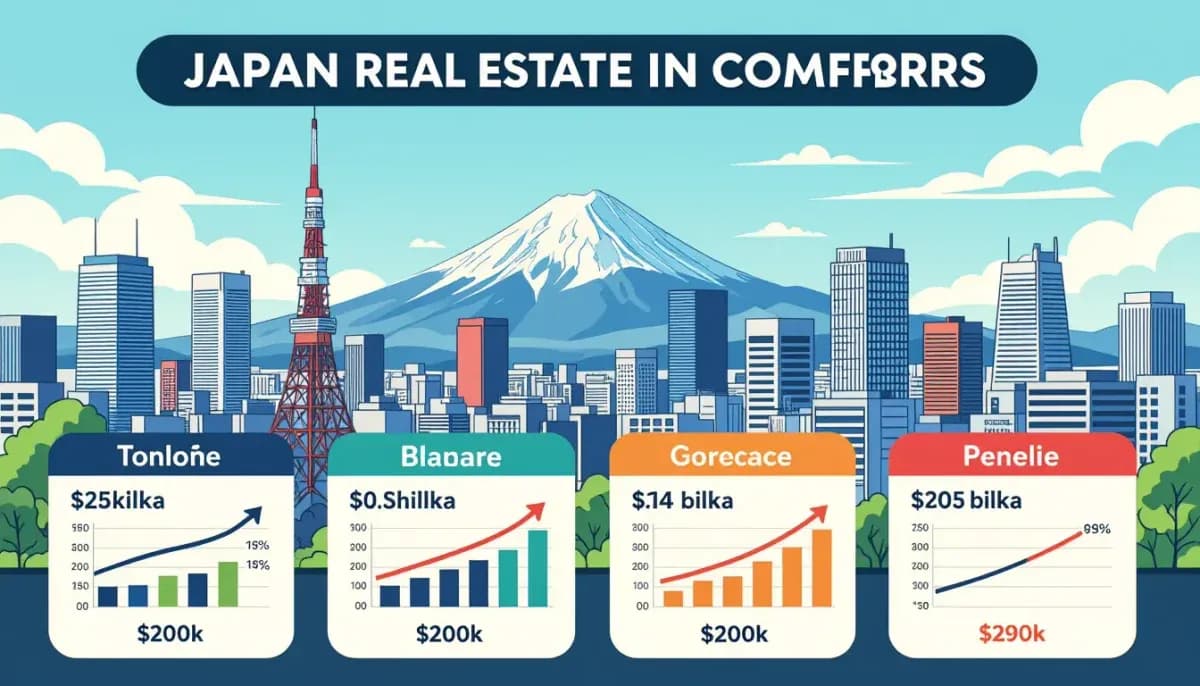
Compare Japan's real estate market against Hong Kong, Singapore, Thailand and other Asian countries. Full analysis of prices, ownership rights, yields, and transaction costs for foreign buyers in 2025.
Japan vs Other Asian Countries: Real Estate Market Comparison
If you're an expat or foreign investor weighing your property options across Asia, Japan stands out in ways that might surprise you. Compared to the sky-high prices of Hong Kong and Singapore, the restrictive ownership laws of Thailand, or the volatility of emerging markets elsewhere in the region, Japan offers a rare combination of full foreign ownership rights, competitive pricing, and a stable, mature market. This guide breaks down the key differences between Japan and other major Asian real estate markets so you can make an informed decision about where to invest.
Why Japan Is Attracting Record Foreign Real Estate Investment
Japan's real estate sector is booming. In 2024, the total market was valued at approximately USD 436 billion, with projections pointing toward USD 557 billion by 2033. More strikingly, foreign investment hit JPY 2.3 trillion (roughly USD 15.7 billion) in 2024—a 12% year-over-year increase. Foreign capital now accounts for 27% of all real estate transactions in Japan, up from just 21% five years earlier.
Tokyo has been ranked the #1 city for cross-border real estate investment for the seventh consecutive year, and up to 40% of new apartment sales in central Tokyo are now going to foreign buyers. What's driving this surge? A favorable exchange rate (the yen weakened to ¥150–160 per USD, giving foreign buyers a 20–30% purchasing advantage over pre-2022 levels), relatively affordable prices by global standards, and a legal framework that fully welcomes foreign ownership.
Nationwide land prices rose +2.7% year-over-year in January 2025—the strongest gain since 1991 and the fourth consecutive annual increase. Major metropolitan areas like Tokyo, Osaka, and Nagoya saw commercial land rise +3.9% and residential land +2.1%. This is a market in motion, and the window for favorable entry may not stay open forever.
For a deeper look at the overall Japan real estate picture, see our Japan Real Estate Market Overview and Trends.
Foreign Ownership Rights: Japan vs the Region
One of Japan's most significant advantages over many Asian markets is its open, non-discriminatory approach to foreign property ownership.
| Country | Foreign Ownership Rules | Restrictions |
|---|---|---|
| Japan | Fully open — same rights as Japanese citizens | Minor restrictions near military zones or agricultural land |
| Hong Kong | Foreigners can buy freely | Additional stamp duties for non-permanent residents |
| Singapore | Condos freely purchasable; HDB (public housing) restricted | Extra stamp duties (ABSD) of 60% for foreigners |
| Thailand | Cannot own land; condos only (max 49% of building) | Strict land ownership prohibition for non-citizens |
| Malaysia | Can buy above minimum price threshold (~MYR 1 million) | Minimum price floors by state |
| Vietnam | 50-year leasehold for foreigners; no freehold | No permanent ownership allowed |
| Philippines | Condos only; no land ownership | Land restricted to Filipino citizens and corporations |
Japan is one of the very few countries in Asia—and indeed the world—where foreigners can purchase land and buildings with no nationality-based restrictions. You don't need to be a resident, you don't need a visa, and there are no special foreigner levies or stamp duties based on nationality. This is a fundamentally different legal environment from Singapore, where foreigners now face an Additional Buyer's Stamp Duty (ABSD) of 60%, or Thailand, where foreign land ownership is outright prohibited.
For full details on ownership rights, see our guide on Can Foreigners Buy Property in Japan? Legal Rights.
Price Comparison: What Your Money Gets in Each Market
Perhaps the most concrete comparison comes down to purchase prices. Here's how Japan stacks up against the region's priciest markets:
| Market | Approximate Price per sqm (USD) | Average 2BR Apartment Price | Notes |
|---|---|---|---|
| Hong Kong | ~25,000 | USD 2 million+ | World's most expensive market |
| Singapore | ~18,000–22,000 | USD 1.5–2 million | Among world's most expensive |
| Tokyo (central) | ~8,000–12,000 | USD 600K–1.2 million | Varies widely by ward |
| Tokyo (outer) | ~4,000–7,000 | USD 300K–600K | Good value vs. HK/Singapore |
| Osaka | ~3,000–5,000 | USD 200K–400K | Strong rental market |
| Sapporo/Fukuoka | ~1,500–3,000 | USD 100K–250K | Affordable regional cities |
Hong Kong's property market is extraordinarily expensive—a modest 2-bedroom apartment in a central district can easily exceed USD 2 million, and prices per square meter regularly hit USD 25,000. Singapore is not far behind. By comparison, Tokyo offers significantly more space and value per dollar, and regional Japanese cities like Osaka, Fukuoka, and Sapporo represent genuine bargains by any global standard.
The yen's weakness adds further appeal. Buyers converting from USD, EUR, SGD, or AUD are effectively buying Japanese property at a structural discount compared to just a few years ago. For guidance on the buying process, see our Step-by-Step Home Buying Process in Japan for Foreigners.
Rental Yields: Japan vs Other Asian Markets
Rental yield is a critical metric for investors. Japan has historically offered solid yields—especially outside Tokyo—and the comparison with other Asian gateway cities is favorable.
| City/Market | Gross Rental Yield (2024–2025) |
|---|---|
| Sapporo, Japan | ~5.0% |
| Osaka, Japan | ~4.5% |
| Japan national average | ~4.2% |
| Tokyo, Japan | ~3.4% |
| Singapore | ~2.5–3.0% |
| Hong Kong | ~2.0–2.5% |
While Tokyo's yields are more modest (~3.4%), they remain above those of Hong Kong or Singapore, where extremely high asset prices compress returns. Osaka yields around 4.5% and smaller cities like Sapporo can reach 5.0%+—levels that attract serious income-oriented investors.
Japan's rental market is also supported by structural factors: low vacancy rates in major cities (central Tokyo sits below 5% vacancy), strong tourism-driven short-term rental demand, and a growing shortage of new supply (housing starts fell to just 792,195 units in 2024, the first time below 800,000 in 15 years).
For more on the financial side of Japan property ownership, see our guides on Mortgages and Home Loans for Foreigners in Japan and Property Taxes and Annual Costs of Owning Property.
Transaction Costs and Ongoing Expenses
Understanding total acquisition costs is essential for any cross-market comparison. Japan's transaction costs are moderate and predictable—no surprise surcharges for foreign buyers.
Japan Transaction Costs:
- Real estate acquisition tax: 3–4% of assessed value
- Registration and license taxes: ~2% of assessed value
- Stamp duty: varies by sale price (typically modest)
- Agent commission: 3% + ¥60,000 + 10% consumption tax
- Annual fixed asset tax: 1.4% of assessed value
- Annual city planning tax: 0.2–0.3% of assessed value
- Typical buyer deposit: 10% of purchase price
Singapore Transaction Costs for Foreigners:
- Additional Buyer's Stamp Duty (ABSD): 60% for foreign buyers (as of 2023)
- Buyer's Stamp Duty (BSD): up to 4–6%
- Total stamp duties alone can add 60%+ to the purchase price
Hong Kong Transaction Costs for Foreigners:
- Buyer's Stamp Duty: 15% for non-permanent residents
- Ad Valorem Stamp Duty: up to 4.25%
- Combined: roughly 20% in extra duties
The contrast is stark. A foreign buyer in Japan faces no nationality-based surcharges whatsoever—you pay exactly what a Japanese citizen would pay. This makes Japan dramatically more cost-effective on a total-acquisition basis compared to Singapore or Hong Kong.
For a full breakdown of Japan's costs, see our guide on Hidden Costs and Fees When Buying Property in Japan.
The Akiya Opportunity: Japan's Unique Vacant Home Market
One feature with no real equivalent in Hong Kong or Singapore is Japan's massive akiya (vacant home) stock. As of the most recent government survey, Japan had approximately 9 million vacant homes nationwide—a record high, representing a vacancy rate of 13.8%. In rural and regional areas, entire villages of abandoned homes are available for minimal cost, sometimes even for free.
This phenomenon creates genuine bargain opportunities for buyers willing to renovate. Some municipalities actively offer akiya for below-market prices (or even free) to attract new residents. While central Tokyo has virtually no such inventory, buyers interested in rural lifestyle, holiday homes, or renovation projects can find properties unavailable anywhere else in Asia at these price points.
For more on this niche, see our guide on Rural and Countryside Properties in Japan for Foreigners.
Market Stability and Long-Term Outlook
Japan's real estate market has a reputation for stability that distinguishes it from some of its more volatile neighbors. The market is transparent, well-regulated, and supported by a deep domestic investor base. Unlike some Southeast Asian markets where property title security can be uncertain, Japan has a robust land registration system and clear legal procedures.
Looking ahead, analysts forecast Tokyo residential prices to rise 5–6% in 2025 (Mitsubishi UFJ Trust). Used apartments in Tokyo's 23 wards posted an astonishing +28.3% year-over-year growth rate in recent data—the highest on record. Pre-owned condo sales in Greater Tokyo rose +27.17% year-over-year in the first half of 2025.
Some risks exist: Japan's aging and shrinking population creates long-term demand uncertainty outside major cities; the concentration of opportunity in Tokyo, Osaka, and a few other hubs means regional diversification carries different risk profiles; and interest rate normalization by the Bank of Japan could cool the market. But for a foreign buyer focused on major cities, the fundamentals remain strong.
Further Resources and Expert Guidance
For expats navigating Japan's property market, several specialized resources can help:
- Living in Nihon's Japan Mortgage Guide — Comprehensive overview of mortgage options for foreigners in Japan
- Gaijin Buy House: Japan Real Estate Investment Guide — Detailed investment strategies for foreign buyers
- For Work in Japan — Resources for expats living and working in Japan
- Japan Real Estate Market 2025–2026 Analysis — In-depth market data and forecasts
- Expat Property Guide to Asia — Regional comparison for international property investors
Is Japan Right for You?
Japan's real estate market offers a compelling proposition for foreign buyers:
- Full ownership rights with no nationality-based restrictions (unlike most of Asia)
- Significantly lower prices than Hong Kong or Singapore
- No discriminatory stamp duties (unlike Singapore's 60% ABSD for foreigners)
- Solid rental yields especially in Osaka and regional cities
- Favorable exchange rates providing a structural purchasing discount
- Market transparency and legal security comparable to Western markets
- Unique opportunities in the akiya market with no equivalent elsewhere in Asia
The trade-offs are real: mortgage access for non-residents is limited (most Japanese banks require permanent residency), certain bureaucratic processes favor Japanese speakers, and long-term population trends create uncertainty in rural areas. But for buyers focused on major cities and willing to navigate a somewhat complex purchasing process, Japan compares exceptionally well to its Asian peers.
Whether you're comparing Tokyo to Singapore, Osaka to Hong Kong, or simply trying to decide where to allocate an investment budget across Asia, Japan deserves serious consideration—and for many foreign buyers in 2025, it's emerging as the standout choice.
To begin your Japan property journey, start with our Complete Guide to Buying Property in Japan as a Foreigner.

Originally from Vietnam, living in Japan for 16+ years. Graduated from Nagoya University, with 11 years of professional experience at Japanese and international companies. Sharing information about buying property in Japan for foreigners.
View Profile →Related Articles
Weak Yen Impact on Japan Property Investment for Foreigners
Learn how Japan's weak yen creates major buying advantages for foreign property investors. Discover real savings, rental yields, legal framework, and key risks to navigate in 2025.
Read more →
Japan Construction Industry Trends and New Home Development
Understand Japan's construction industry trends, new home development statistics, prefab housing growth, labor challenges, and what it means for foreign buyers planning to purchase or build in Japan.
Read more →
Best Cities to Invest in Japan Real Estate in 2026
Discover the top Japanese cities for real estate investment in 2026. Compare Tokyo, Osaka, Fukuoka, Sapporo rental yields, prices, and tips for foreign buyers entering the market.
Read more →
Japan Property Market Bubble History: Lessons for Today's Buyers
Learn from Japan's 1991 property bubble collapse — when prices fell 90% — and apply those hard-won lessons to buying property in Japan as a foreigner in 2025's rising market.
Read more →
Japan Luxury Real Estate Market Trends for High-Net-Worth Buyers
Discover Japan's luxury real estate market trends for 2026. Tokyo prices, Niseko resort properties, foreign buyer rules, financing tips, and strategic insights for high-net-worth buyers.
Read more →
Japan New Build vs Used Housing Market Comparison
Compare new build (shinchiku) vs used (chuko) housing in Japan. Prices, depreciation, pros and cons, mortgage access, and which option suits foreign buyers best in 2025.
Read more →