
Flood Insurance Coverage Options for Japan Property Owners

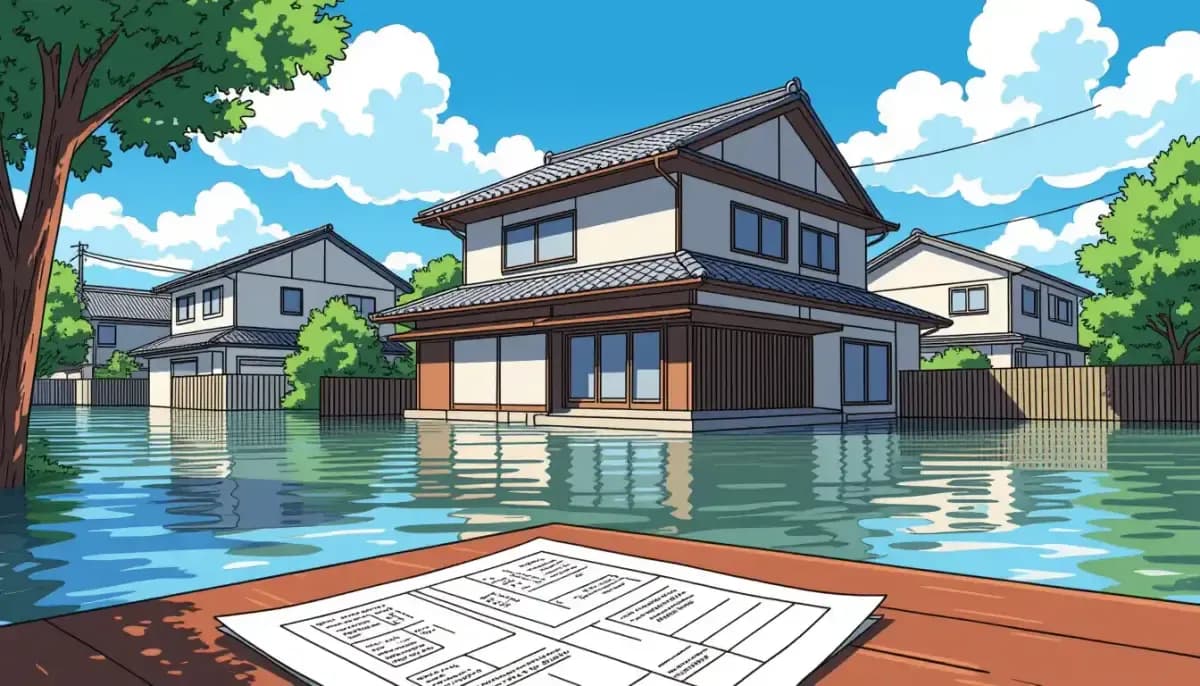
Learn how flood insurance works in Japan, what water disaster coverage includes, payout thresholds, costs, and how foreigners can get covered. Complete guide for property owners.
Flood Insurance Coverage Options for Japan Property Owners
Japan is one of the world's most disaster-prone countries. With typhoons striking every year, rivers overflowing from torrential rains, and climate change increasing the intensity of extreme weather events, flood risk is a real and growing concern for property owners. If you own property in Japan — whether as a resident or a foreign investor — understanding your flood insurance options is essential to protecting your investment.
This guide breaks down everything you need to know about flood insurance in Japan: how it works, what it covers, how much it costs, and how foreigners can get covered.
How Flood Insurance Works in Japan: The Basics
Unlike some countries where flood insurance exists as a separate policy, Japan does not offer standalone flood insurance. Instead, flood coverage — officially called 水災補償 (suisai hosho, water disaster coverage) — is sold as an optional rider attached to fire insurance (火災保険, kasai hoken).
This means you must first purchase fire insurance, and then elect to add water disaster coverage on top of it. Without this add-on, your property has no protection against flood-related damage.
Fire insurance itself is typically mandatory when financing property through a Japanese bank, but the flood rider is optional. As a result, many property owners unknowingly skip it and find themselves unprotected when disaster strikes.
For a deeper look at the base policy, see our guide on Fire Insurance (Kasai Hoken) for Japan Homeowners.
What Flood Insurance Covers in Japan
Water disaster coverage in Japan is broad. When you add the water disaster rider to your fire insurance policy, you are typically protected against:
- Typhoon and storm damage — damage caused by high winds combined with rain
- River flooding — inundation from rivers overflowing due to heavy rain
- Urban flooding — water accumulation from overwhelmed drainage systems
- Storm surges — coastal flooding caused by low atmospheric pressure during typhoons
- Snowmelt floods — flooding caused by rapid snow melting in spring
- Landslides, mudflows, and falling rocks — ground movement triggered by saturation
Coverage can apply to the building structure, household goods, or both — depending on the policy you choose. Renters typically insure only household goods, while homeowners usually cover both.
What Is NOT Covered
Flood insurance in Japan has important exclusions you must know about:
- Earthquake-triggered flooding — if a flood or landslide is caused by an earthquake, it requires separate Earthquake Insurance in Japan, not the water disaster rider
- Tsunami damage — tsunamis caused by earthquakes are excluded from standard flood coverage
- Minor water damage from leaks — toilet overflows, plumbing leaks, and condensation are not flood events
- Sludge accumulation without inundation — debris and sediment alone may not qualify without a measurable flood event
The Payout Threshold: When Will Insurance Actually Pay?
This is one of the most critical — and often misunderstood — aspects of flood insurance in Japan. Insurance companies require both of the following conditions to be met before paying a flood claim:
- Inundation must reach at least 45 centimeters (cm) above ground level — or reach floor level inside the structure
- Damage must exceed 30% of the property's replacement value
These thresholds mean that moderate flooding that doesn't quite reach 45cm — even if it causes real damage — may not trigger a payout. This is especially important for basement or ground-floor areas of properties.
The 45cm rule is a significant limitation that many property owners discover only after a flood. When selecting coverage, ask your insurance agent to explain exactly how payout thresholds would apply to your specific property structure.
How Much Does Flood Insurance Cost in Japan?
Japan's flood insurance premium structure changed significantly with the introduction of a 5-tier risk classification system (Class 1–5). Premiums are now based on:
- Flood hazard maps published by local governments
- Historical flood damage statistics in the area
- Topographical data (elevation, proximity to rivers, etc.)
- Building type — wooden homes (H-class) are significantly more expensive to insure than reinforced concrete apartments (M-class)
The highest-risk Class 5 areas pay approximately 1.2 times more than the lowest-risk Class 1 areas.
Here is a general cost overview:
| Coverage Type | Annual Cost (Approximate) |
|---|---|
| Fire insurance only (condo, no flood) | ¥4,450 – ¥15,000 |
| Fire insurance + flood rider (condo) | ¥10,000 – ¥39,200 |
| Fire insurance + flood rider (wooden house) | ¥20,000 – ¥50,000 |
| Earthquake insurance add-on | Additional ¥20,000 – ¥50,000 |
| Full package (fire + flood + earthquake) | ¥40,000 – ¥100,000+ |
Costs based on typical properties in Tokyo area; actual premiums depend on location, building age, and coverage amount.
For a detailed breakdown of all property insurance costs, see our Japan Property Insurance Premium Costs and Comparison guide.
Why Flood Coverage Is More Important Than You May Think
Japan's flood risk is serious and growing. Consider these facts:
- 23.1% of Japanese households — approximately 1.23 million homes — are located in areas at risk of landslides or flood disasters, according to Japan's Ministry of Land, Infrastructure, Transport, and Tourism (MLIT)
- The provisional total flood damage in 2019 reached ¥2.15 trillion (approximately $19.73 billion USD)
- The Bank of Japan projects that flood damage could increase by a factor of nine by the year 2100 due to climate change
- Despite this, flood coverage rates have been declining: from ~80% of households in 2013 to just over 60% in 2022
This declining coverage trend is concerning. One reason is that flood coverage is optional and requires an active decision to add it. Another is that many property buyers, particularly foreigners, are unaware of the separate rider requirement.
Areas at particularly high risk include properties near major rivers like the Arakawa in Tokyo, low-lying areas of Osaka, typhoon-prone coastal regions in Fukuoka and Kagoshima, and mountainous areas throughout western Japan prone to landslides and mudflows.
How to Assess Your Flood Risk Before Buying Property
Since August 28, 2020, Japanese law requires real estate agents to disclose hazard map information to buyers before signing a property contract. This means every property transaction must include a discussion of flood, landslide, and tsunami risk based on government-published maps.
Here is how to assess your property's flood risk:
- Check the National Hazard Map Portal (ハザードマップポータルサイト) — Japan's government provides an online portal where you can look up any address
- Review local government hazard maps — each municipality publishes flood inundation maps showing expected water depth by risk scenario
- Ask your real estate agent — they are now legally required to provide this information and explain it to you
- Consult your insurance agent — show them the hazard map data and ask which risk class your property falls into
Even if you have already purchased a property, you can look up your address on hazard maps to determine whether adding flood coverage is advisable.
For guidance on finding a trustworthy real estate agent who can help with these disclosures, visit How to Find a Real Estate Agent in Japan as a Foreigner.
How to Get Flood Insurance as a Foreign Property Owner
Foreigners can absolutely obtain flood and property insurance in Japan. There are no legal restrictions on foreign nationals purchasing property insurance, and the process is essentially the same as for Japanese nationals.
Requirements
- Valid residence card (在留カード) or special permanent resident certificate
- Japanese address for the insured property
- Japanese bank account (for premium payments)
- Emergency contact person in Japan (required by some insurers)
Non-residents purchasing property as an investment may face additional requirements. Some insurers require a legally authorized representative (代理人) in Japan who can manage enrollment and claims on your behalf. Processing typically takes 1–3 weeks.
English-Language Friendly Insurance Providers
The language barrier is a real challenge when purchasing insurance in Japan, as most policies and customer service are in Japanese. The following providers are known for offering English-language support:
| Provider | English Support | Notes |
|---|---|---|
| TRINITY Inc. | Full English | Specialists in expat insurance |
| AIG Japan | Multilingual | International insurer, strong English support |
| Chubb Insurance Japan | English available | Good for non-resident foreign investors |
| Tokio Marine Nichido | Limited English | Japan's largest insurer; may need bilingual agent |
| Sompo Japan | Limited English | More flexible underwriting for non-residents |
For a full comparison of providers available to foreigners, see Japan Property Insurance Companies: Comparison for Foreigners.
Filing a Flood Insurance Claim in Japan
If your property is damaged by a flood, act quickly and document everything. Here is the general process:
- Contact your insurer immediately — most policies require prompt notification
- Document all damage with photos and videos before cleaning up
- Measure water levels if possible — the 45cm threshold matters for your claim
- Keep all repair receipts and estimates — insurers will need documentation of costs
- Submit the claim form — in Japanese; ask your insurer if an English version is available
- Cooperate with the adjuster — an insurance assessor will inspect the property
Payout amounts are based on the replacement cost of the damaged portions. Most policies pay on a sliding scale based on damage severity relative to the 30% threshold.
For a full walkthrough of the claims process, see How to File an Insurance Claim in Japan: Property Owner Guide.
Flood Insurance for Condominiums vs. Detached Houses
Coverage considerations differ significantly between these two property types.
Condominiums (Mansions): The building structure is typically covered by the condominium association's building insurance, paid through monthly management fees. Individual owners are responsible for insuring their interior finishings and household goods. Always ask the management association what the building insurance covers and whether water disaster coverage is included. For details, see Condominium Building Insurance Guide for Owners in Japan.
Detached Houses (Ikkodate): Homeowners are fully responsible for both building and contents insurance. Flood risk is typically higher for ground-level structures, making water disaster coverage more important.
Rental Properties: If you own a property you rent out to tenants, you will need landlord insurance that covers the structure (and optionally the contents). Tenants should carry their own renter's insurance for their belongings. See Landlord Insurance for Rental Property in Japan for more.
External Resources for Japan Flood Insurance
For additional research and perspectives on property insurance in Japan:
- Homeowners Insurance in Japan: Fire and Flood Insurance Explained — Comprehensive overview from Japan Real Estate resources
- Flood Insurance for Water Disaster in Japan — Detailed coverage from Plaza Homes
- Full Guide to Home Insurance in Japan — AkiyaHub's comprehensive guide
- Living in Nihon: Japan Life Guide for Foreigners — General resource for foreigners in Japan
- Housing Guide for Foreigners in Japan — Housing and living infrastructure for foreign residents
- Home Insurance and Warranty System Guide for Foreigners — Gaijin Buy House's comprehensive insurance guide
Key Takeaways
Flood insurance in Japan requires active planning. It is not automatic, not mandatory (unlike fire insurance in mortgage situations), and not intuitive for foreign property owners navigating an unfamiliar system. Here is a quick summary of what to remember:
- Flood coverage is an optional rider on fire insurance, not a separate policy
- Payouts require 45cm+ inundation and 30%+ damage threshold — both conditions must be met
- 23%+ of Japanese properties are in flood or landslide risk zones — check hazard maps
- Annual costs range from around ¥10,000 to ¥50,000+ depending on property type and location
- English-language providers including TRINITY Inc., AIG Japan, and Chubb Insurance Japan are available for foreign buyers
- Since 2020, hazard map disclosure is legally required before property contracts
Protecting your Japan property investment starts with understanding what you are — and are not — covered for. Review your current fire insurance policy today, check the hazard map for your property, and talk to your insurance agent about whether adding water disaster coverage makes sense for your situation.
For a complete overview of all insurance types available to property owners in Japan, see our Insurance for Property Owners in Japan: Complete Guide.

Originally from Vietnam, living in Japan for 16+ years. Graduated from Nagoya University, with 11 years of professional experience at Japanese and international companies. Sharing information about buying property in Japan for foreigners.
View Profile →Related Articles
Natural Disaster Insurance Coverage Gaps in Japan
Discover dangerous coverage gaps in Japan's natural disaster insurance system — earthquake, flood, and typhoon risks foreign property owners frequently overlook, with practical steps to protect yourself.
Read more →
Japan Property Insurance Renewal and Annual Review Guide
A complete guide to reviewing and renewing property insurance in Japan as a foreign owner. Covers fire insurance, earthquake insurance, the 2025 policy term changes, costs, and annual review checklists.
Read more →
Insurance for Vacant Properties and Akiya in Japan
Learn how to insure your akiya or vacant property in Japan as a foreigner. Covers fire insurance, earthquake coverage, costs, providers, and tips for non-residents.
Read more →
Japan Property Insurance Exclusions and Limitations to Know
Learn what Japan property insurance does NOT cover: earthquake damage, flood exclusions, basement flooding, commercial use limits, and more. Essential guide for foreign buyers.
Read more →
Japan Property Insurance Companies: Comparison for Foreigners
Compare Japan's top property insurance companies for foreigners. Learn about fire insurance, earthquake insurance costs, English-friendly providers, and how to apply as an expat.
Read more →
How to File an Insurance Claim in Japan: Property Owner Guide
Step-by-step guide to filing property insurance claims in Japan for foreigners. Learn Japan's three-tier damage system, required documents, language tips, and non-resident claim strategies.
Read more →