
Disaster Rebuilding and Insurance Claims Process in Japan

Learn how Japan's earthquake insurance and disaster rebuilding process works for foreign homeowners. Covers claims steps, payout tiers, premiums, and practical tips for expats.
Disaster Rebuilding and Insurance Claims Process in Japan
Japan sits at the intersection of multiple tectonic plates, making it one of the most seismically active countries on Earth. For foreign property owners and residents, understanding the disaster rebuilding and insurance claims process in Japan is not optional—it is essential. Whether you own a home in Tokyo, Osaka, or a rural town in Tohoku, a major earthquake, typhoon, or flood could strike at any time. This guide walks you through everything you need to know about Japan's disaster insurance system, how to file a claim, and what the rebuilding process looks like.
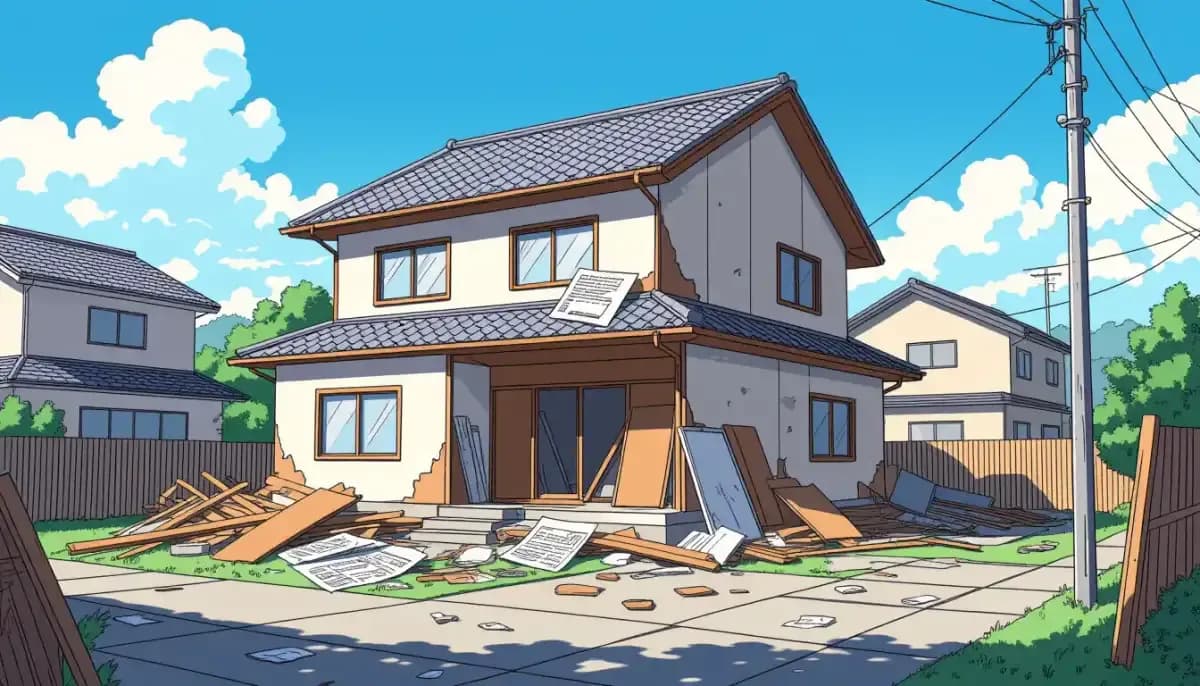
!Earthquake-damaged house in Japan with insurance forms and rebuilding materials nearby
Understanding Japan's Earthquake Insurance System
Japan's earthquake insurance system is a public-private partnership established in 1966, designed to provide financial support to disaster victims. Private insurance companies underwrite the policies, but the government—through the Japan Earthquake Reinsurance Company (JER)—acts as a massive backstop reinsurer. The combined reinsurance limit stands at 12 trillion yen per event, calibrated to handle a disaster equivalent to the catastrophic 1923 Great Kanto Earthquake.
Despite this robust structure, only 35.1% of Japanese households held earthquake insurance as of 2023. This means the majority of property owners remain financially exposed to disaster risk. For foreigners purchasing property in Japan, this statistic is a call to action.
The Relationship Between Fire Insurance and Earthquake Insurance
One of the most misunderstood aspects of Japan's insurance framework is that earthquake insurance cannot be purchased as a standalone policy. It must be purchased as a rider attached to a fire insurance policy (火災保険, kasai hoken). This is a hard legal requirement.
Here is what this means in practice:
- You must first purchase fire insurance for your property.
- You then add earthquake insurance (地震保険, jishin hoken) as an add-on.
- Your earthquake coverage is limited to 30–50% of the fire insurance coverage amount.
- Maximum caps are ¥50 million for the building structure and ¥10 million for household contents.
Standard fire insurance explicitly does NOT cover earthquake-caused fires, tsunamis, or volcanic eruptions. Many homeowners discover this gap too late. Even if fire consumes your home following an earthquake—as happened across Kobe in 1995—you need earthquake insurance to collect.
For a deeper overview of owning property in Japan and understanding annual costs, see our guide on property taxes and annual costs in Japan.
What Earthquake Insurance Covers (and What It Doesn't)
Covered Events
Japan's earthquake insurance covers damage to residential buildings and household goods caused by:
- Earthquakes (地震)
- Volcanic eruptions (火山噴火)
- Tsunamis (津波)
And the resulting damage types include: fire, collapse, burial under debris, flooding, and being washed away.
What Is NOT Covered
| Exclusion Category | Details |
|---|---|
| Non-residential buildings | Shops, offices, investment properties are excluded |
| High-value items | Valuables exceeding ¥300,000 per item (jewelry, art) |
| Currency and securities | Cash, stocks, bonds |
| Vehicles | Cars, motorcycles |
| Delayed damage | Damage occurring 10+ days after the earthquake event |
| Intentional damage | Self-inflicted or fraudulent claims |
| War and civil unrest | Damage caused by military actions |
For renters: you can only insure your household contents, not the building structure. The landlord is responsible for insuring the structure itself.
How Payouts Are Calculated: The Four-Tier System
Unlike proportional insurance in many Western countries, Japan's earthquake insurance uses a tiered payout system. Your damage is assessed and classified into one of four categories, and you receive a fixed percentage of your insured amount based on that tier.
| Damage Level | Assessment Criteria | Payout Percentage |
|---|---|---|
| Total Loss (全損) | 50%+ structural damage, or 70%+ floor area destroyed | 100% |
| Large Half Loss (大半損) | Major but sub-total structural damage | 60% |
| Small Half Loss (小半損) | 20–40% building damage | 30% |
| Partial Loss (一部損) | 3–20% damage | 5% |
| Below Threshold | Under 3% damage | 0% (no payout) |
Example: If you have ¥10 million in earthquake coverage and your home is assessed as "Small Half Loss," you receive ¥3 million (30%). This is designed as livelihood support, not a complete replacement of your property value. For this reason, experts recommend purchasing earthquake insurance at the maximum allowed amount (50% of fire insurance coverage).
!Insurance adjuster inspecting earthquake damage to a Japanese residential building
The Step-by-Step Insurance Claims Process
If disaster strikes, acting quickly and methodically is critical. Here is the complete claims process:
Step 1: Contact Your Insurer Immediately
Call your insurance company's emergency line as soon as it is safe to do so. Most major insurers have 24/7 hotlines. Have your policy number ready. Companies like Tokio Marine, Sompo Japan, and MS&AD (Mitsui Sumitomo) offer English-language support lines.
Step 2: Document All Damage Thoroughly
Before touching anything, take comprehensive photographs and videos of all damage:
- Exterior walls, roof, foundation cracks
- Interior damage: collapsed ceilings, broken walls, flooded rooms
- Damaged household goods with timestamps
- Wide shots showing overall structural conditions
This documentation is your evidence base. Insufficient documentation is the leading cause of reduced or denied claims.
Step 3: Submit Documentation to Insurer
Submit your:
- Completed claim form (理由書)
- Photographs of damage
- Repair estimates from licensed contractors
- Proof of insured value (original purchase price, appraisal)
Step 4: Insurer Sends an Adjuster
An insurance adjuster (損害査定人) will visit your property to conduct an independent assessment. This inspection determines which damage tier applies. During the visit:
- Be present if at all possible
- Walk the adjuster through all damage points
- Provide your photographic evidence as a reference
Step 5: Damage Classification and Payout
After inspection, the insurer issues a formal damage classification letter. Payouts are typically issued within 1–2 months of the initial claim, though this can extend significantly during large-scale disaster events (as seen after the 2011 Tohoku earthquake, which generated approximately 1.29 trillion yen in claims).
If you disagree with the damage classification, you have the right to request a re-inspection and submit additional evidence.
For detailed guidance on legal documentation and property ownership procedures, see legal procedures and documentation for Japan property purchase.
Cost of Earthquake Insurance Premiums
Insurance premiums vary based on several factors:
| Factor | Low Cost | High Cost |
|---|---|---|
| Building construction | Reinforced concrete | Wooden structure |
| Location | Low seismic risk zone | Tokyo/Kanto high-risk zone |
| Building age | Post-1981 (new seismic code) | Pre-1981 (old code) |
| Seismic certifications | Grade 3 certified | No certification |
Approximate Annual Premium Ranges
- Wooden detached house in high-risk area: ~¥100,000–¥120,000/year
- Reinforced concrete apartment in mid-risk area: ~¥30,000–¥55,000/year
- Multi-year contracts (up to 5 years) offer discounts of up to 20%
Available Discounts
| Discount Type | Reduction |
|---|---|
| Seismic isolation technology | Up to 50% |
| Seismic Grade 3 certification | Up to 50% |
| Post-1981 construction standard | ~10% |
| Earthquake resistance diagnosis completed | 10% |
Tax Deductions
Earthquake insurance premiums are tax-deductible in Japan:
- Up to ¥50,000/year for national income tax
- Up to ¥25,000/year for local inhabitants tax
This deduction can be claimed through your year-end tax adjustment (年末調整) as an employee, or through your annual tax return (確定申告) as a self-employed individual or property investor.
For an overview of all the ongoing financial obligations of property ownership, read our article on hidden costs and fees when buying property in Japan.
Government Disaster Support: What You Can Expect
Beyond private insurance, Japan's government provides public support to disaster victims under the Act on Support for Reconstructing the Livelihoods of Disaster Victims (被災者生活再建支援法). However, the maximum public assistance is approximately ¥3 million, which is entirely insufficient for rebuilding a home in Japan's major cities.
Government support covers:
- Basic support grant: Up to ¥1 million for total housing loss
- Supplementary support grant: Additional ¥2 million for rebuilding, purchasing, or renting a new home
This reinforces why private earthquake insurance is so critical. Public funds are a safety net, not a rebuilding fund.
For help understanding your overall financial positioning as a foreign property owner, Living in Nihon and For Work in Japan both offer practical financial guidance for foreign residents navigating Japanese systems.
Advice for Foreign Residents Filing Claims
Filing insurance claims in Japan as a foreigner presents unique challenges. Here is what you need to know:
Eligibility
Foreign residents with a valid visa and a registered Japanese address (住民票, jūminhyō) are fully eligible to purchase and claim earthquake insurance. Requirements typically include:
- Japanese bank account for premium payments and claim disbursements
- Resident registration (住民票) confirming your Japanese address
- Property ownership documents or lease agreement
Language Barriers
All policy documents, claim forms, and adjuster communications will be in Japanese. Options to manage this:
- Request a bilingual agent when purchasing your policy (Tokio Marine and Sompo Japan have English-language services)
- Use a bilingual insurance broker who can translate and advocate on your behalf
- Appoint a trusted Japanese-speaking representative (family member, colleague, or attorney) to handle claim correspondence
Practical Preparation Tips
- Store your policy documents in your disaster kit — not just digitally, but as a printed copy in a waterproof bag
- Register your insurer's emergency number in your phone contacts
- Use hazard maps (ハザードマップ) — search "[your city] + ハザードマップ" to understand your flood and earthquake risk profile
- Compare premiums on Kakaku.com and consult Hoken no Madoguchi for free multilingual insurance consultations
- Never underinsure — set earthquake coverage to the maximum 50% of fire insurance
For expats looking at comprehensive property resources, Gaijin Buy House offers property guides tailored to foreign buyers and owners in Japan.
The Rebuilding Process After a Disaster
Once your insurance payout is received, the rebuilding process typically involves:
Phase 1: Safety Assessment
Local municipal authorities conduct safety inspections and issue damage certificates (罹災証明書, risai shōmeisho). This document is required for:
- Additional government support applications
- Tax relief applications
- Contractor permits and demolition approvals
Apply for your damage certificate at your local municipal office (市役所) as soon as possible after a disaster — processing times can extend for months during mass disaster events.
Phase 2: Demolition and Site Clearing
If the structure is condemned or must be demolished, work with:
- A licensed demolition contractor (解体業者)
- Your municipality, which often provides subsidized demolition services after declared disasters
- Your insurance company adjuster to confirm demolition is covered under your policy terms
Phase 3: Design and Contractor Selection
Rebuilding in Japan requires working with licensed architects and contractors. Key considerations:
- Use contractors certified under Japan's Building Standards Act post-2000 revision
- Prioritize seismic-resistant construction (耐震構造) or seismic isolation (免震構造) designs
- Obtain multiple quotes — construction costs in Japan vary significantly by region and material
Phase 4: Permits and Construction
All new construction requires building permits (建築確認申請) from your local government. Processing typically takes 3–6 weeks in non-disaster conditions but can be accelerated in declared disaster zones.
For a full picture of the home buying and rebuilding landscape in Japan as a foreigner, our comprehensive guide on buying property in Japan as a foreigner is an essential starting point.
Also see detailed reference information at Japan's Earthquake Insurance System - Ministry of Finance and Earthquake Insurance Guide for Expats - ARealty.
Conclusion
Japan's disaster insurance landscape is carefully designed but requires proactive engagement. For foreign property owners, the combination of earthquake insurance, thorough documentation habits, and awareness of government support systems creates a solid financial safety net. The single most important step is ensuring you have earthquake insurance attached to your fire insurance policy before disaster strikes—not after.
Given that only 35.1% of Japanese households currently hold earthquake insurance, acting now places you ahead of the vast majority of homeowners in Japan. Use a bilingual insurance agent, maximize your coverage to the legal limit, and store your documents in a secure, accessible location.
For additional guidance on navigating Japan's property and legal systems as a foreigner, explore our guides on mortgages and home loans for foreigners in Japan and the step-by-step home buying process in Japan.

Originally from Vietnam, living in Japan for 16+ years. Graduated from Nagoya University, with 11 years of professional experience at Japanese and international companies. Sharing information about buying property in Japan for foreigners.
View Profile →Related Articles

Climate Change Impact on Japan Property Risk Assessment
Learn how climate change affects Japan property risk—flood zones, earthquake hazards, typhoon exposure—and how foreign buyers can assess risk using Japan's hazard maps and mandatory disclosure rules.
Read more →
How to Read and Use Japan Hazard Maps for Property Purchase
Learn how to read and use Japan's official hazard maps before buying property. Understand flood, earthquake, and tsunami risk zones with this step-by-step guide for foreign buyers.
Read more →
Emergency Supplies and Kit Guide for Japan Homeowners
Build the perfect emergency kit for your Japan home. Essential bosai bag checklist, where to buy supplies, and special tips for foreign homeowners in earthquake-prone Japan.
Read more →
Creating a Disaster Evacuation Plan for Your Japan Home
Learn how to create a disaster evacuation plan for your Japan home as a foreign homeowner. Covers Japan's alert systems, hazard maps, emergency kits, shelter locations, and post-disaster rights for foreigners.
Read more →
Seismic Retrofitting Options for Older Homes in Japan
Learn about seismic retrofitting options for older homes in Japan: costs, government subsidies up to ¥3M, tax incentives, and step-by-step process for foreign buyers.
Read more →
Japan Earthquake-Resistant Building Standards Explained
Understand Japan's earthquake-resistant building standards (Shin-Taishin, 1981, 2000 codes), taishin/seishin/menshin systems, seismic grades, and how to verify compliance when buying property in Japan.
Read more →