
Types of J-REITs: Sector Comparison and Analysis

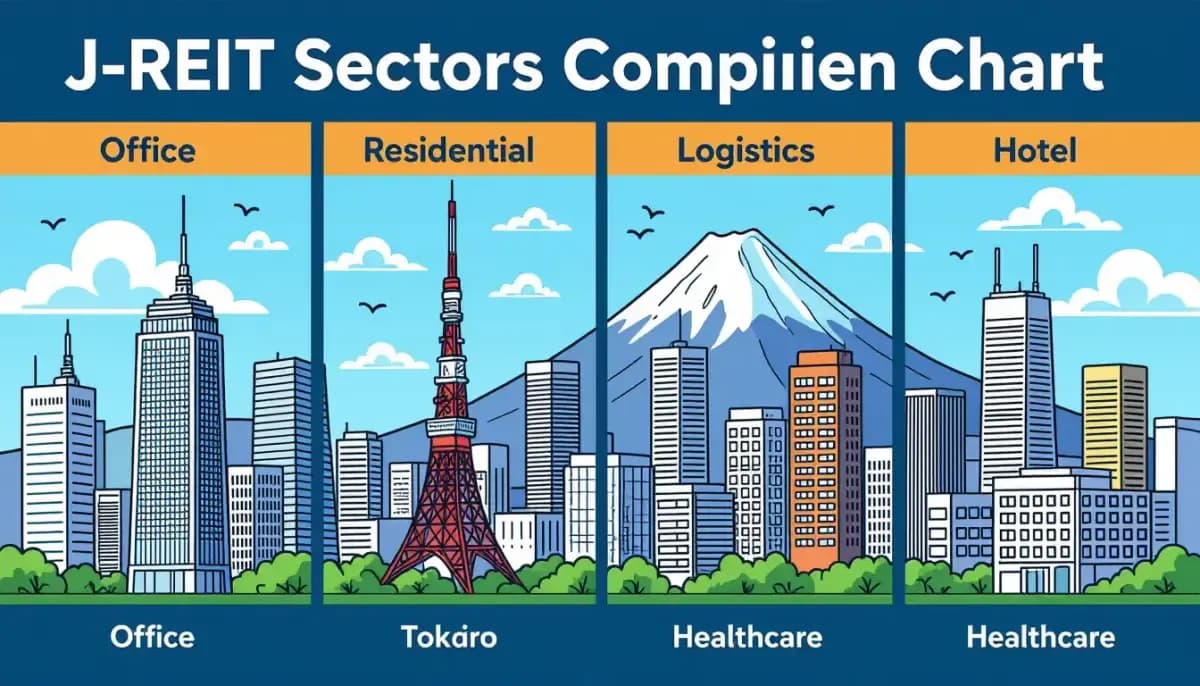
Compare all 7 J-REIT sectors in Japan — office, residential, logistics, hotel, healthcare, retail, and diversified. Yields, risks, and how foreigners can invest.
Types of J-REITs: Sector Comparison and Analysis
Japan's real estate investment trust market — known as J-REITs — is the second largest in the world after the United States, with 58 listed funds and a combined market capitalization of approximately ¥15.36 trillion as of March 2024. For foreign investors seeking exposure to Japanese real estate without the complexity of direct property ownership, understanding the different J-REIT sectors is essential. Each sector targets different asset classes, carries distinct risk profiles, and delivers varying dividend yields.
This guide breaks down every major J-REIT sector, compares their characteristics, and helps you identify which types may suit your investment goals as a foreign investor.
The 7 Major J-REIT Sectors Explained
Japan's J-REIT market is organized into seven primary property sectors, each focusing on a distinct asset class. Understanding these categories is the foundation for building a sound indirect real estate investment strategy.
1. Office REITs
Office REITs invest primarily in commercial office buildings, predominantly in Japan's major business districts — Tokyo's Marunouchi, Shinjuku, and Shibuya, as well as Osaka's Umeda corridor and Nagoya's Sakae district.
These funds tend to offer stable income backed by long-term corporate leases, typically spanning 2 to 5 years. Office J-REITs were hit hard during the COVID-19 pandemic as remote work trends reduced office demand, but many have since recovered as Japanese companies — which tend to favor in-office work culture — resumed full occupancy.
Key characteristics:
- Tenant base: Large corporations and financial institutions
- Lease length: 2–5 years
- Vacancy sensitivity: Moderate (leases provide buffer)
- Typical yield: 3.0%–4.5%
Notable example: Nippon Building Fund (NBF) is Japan's largest office J-REIT with a market capitalization of approximately ¥1.28 trillion.
2. Residential REITs
Residential J-REITs own and manage apartment complexes across Japan, particularly in major metropolitan areas. These funds benefit from Japan's persistent urban migration trend, particularly toward Tokyo, which continues to attract young workers despite the country's overall population decline.
Rental demand in central Tokyo remains robust, and vacancy rates in well-managed residential REITs tend to stay below 5%. Residential REITs typically offer lower yields than office or logistics funds but deliver higher stability — individual apartment leases renew frequently, allowing rents to adjust to market rates.
Key characteristics:
- Tenant base: Individual renters (mostly young urban workers)
- Lease length: 2 years (standard in Japan)
- Vacancy sensitivity: Low in urban cores
- Typical yield: 3.0%–4.0%
3. Retail REITs
Retail J-REITs invest in shopping centers, malls, and retail complexes. Japan's retail REIT sector faced significant headwinds from e-commerce growth and the pandemic, but suburban shopping centers anchored by grocery and daily-needs tenants have proven more resilient than fashion-focused urban malls.
Many retail REITs have pivoted toward "everyday use" retail formats that are less susceptible to online competition. Investors should evaluate a retail REIT's tenant mix carefully — a mall anchored by a major supermarket chain is fundamentally different from one reliant on fashion brands.
Key characteristics:
- Tenant base: Retail chains, supermarkets, restaurants
- Lease length: 5–20 years (anchor tenants often longer)
- Vacancy sensitivity: High for fashion retail, low for necessity retail
- Typical yield: 4.0%–5.5%
4. Logistics REITs
Logistics J-REITs are among the fastest-growing sector, owning warehouses, distribution centers, and last-mile delivery facilities. The e-commerce boom has driven enormous demand for modern logistics infrastructure across Japan, and this sector has consistently outperformed others in recent years.
Japan's logistics infrastructure was historically underdeveloped compared to Western markets, meaning new Class-A warehouse facilities command significant rent premiums. Logistics REITs typically carry long lease terms (often 10+ years) with stable corporate tenants including Amazon Japan, Yamato Transport, and Sagawa Express.
Key characteristics:
- Tenant base: E-commerce companies, logistics operators
- Lease length: 5–20 years
- Vacancy sensitivity: Very low (structural undersupply)
- Typical yield: 3.5%–4.5%
5. Hotel REITs
Hotel J-REITs were among the hardest hit during COVID-19, when Japan's borders were closed and inbound tourism collapsed. However, Japan's dramatic tourism recovery in 2023 and 2024 — driven by the weak yen attracting record numbers of overseas visitors — has revived this sector significantly.
Hotel REITs operate under two main structures: fixed-rent leases (more stable) and variable-rent arrangements tied to revenue-per-available-room (RevPAR) metrics. The latter offer higher upside during tourism booms but more downside during crises.
Key characteristics:
- Tenant base: Hotel operators (Marriott, APA, Daiwa Roynet, etc.)
- Lease length: Variable (fixed or revenue-linked)
- Vacancy sensitivity: High (highly cyclical)
- Typical yield: 4.0%–6.5% (highest variance of any sector)
Notable example: Invincible Investment Corporation, which focuses heavily on hotels, offers one of the market's highest yields at approximately 6.55%.
6. Healthcare REITs
Healthcare J-REITs invest in elderly care facilities, nursing homes, and clinics. This is the smallest sector by number of funds but arguably the most strategically positioned for Japan's long-term demographic trends — Japan has the world's oldest population, with over 29% aged 65 or older.
Government backing for elderly care facilities and long-term supply/demand imbalances in senior housing make this a compelling defensive sector. However, healthcare REITs carry regulatory risk and are sensitive to changes in government reimbursement policies.
Key characteristics:
- Tenant base: Care operators, healthcare providers
- Lease length: 10–20 years
- Vacancy sensitivity: Very low
- Typical yield: 4.0%–5.0%
7. Diversified REITs
Diversified J-REITs hold assets across multiple sectors within a single fund. These are often referred to as "complex" or "composite" REITs and offer built-in diversification. While they sacrifice sector-specific upside, they tend to be more resilient during downturns affecting any single asset class.
Key characteristics:
- Asset mix: Varies by fund strategy
- Typical yield: 3.5%–5.0%
- Best for: Investors who want J-REIT exposure without sector concentration risk
J-REIT Sector Comparison Table
| Sector | Typical Yield | Lease Length | Vacancy Risk | COVID Impact | Long-Term Outlook |
|---|---|---|---|---|---|
| Office | 3.0–4.5% | 2–5 years | Medium | High | Moderate |
| Residential | 3.0–4.0% | 2 years | Low | Low | Strong |
| Retail | 4.0–5.5% | 5–20 years | Medium-High | High | Mixed |
| Logistics | 3.5–4.5% | 5–20 years | Very Low | Low | Very Strong |
| Hotel | 4.0–6.5% | Variable | Very High | Severe | Recovering |
| Healthcare | 4.0–5.0% | 10–20 years | Very Low | Low | Strong |
| Diversified | 3.5–5.0% | Mixed | Low-Medium | Mixed | Stable |
How Foreign Investors Can Access J-REIT Sectors
J-REITs are listed on the Tokyo Stock Exchange and can be purchased by foreign investors through international brokers that offer TSE access. Unlike direct property investment in Japan — which, while legally permitted, involves complex financing, documentation, and management logistics — J-REITs offer a straightforward entry point.
Investment routes for foreigners:
- International brokers (Interactive Brokers, Saxo Bank, etc.): Simplest route; no Japanese address required
- Japanese domestic brokerage accounts (Rakuten Securities, SBI Securities): Requires a Japanese address and residence card (在留カード)
- ETFs and funds: Japan Real Estate ETFs bundle multiple J-REITs for instant diversification
For a complete guide on purchasing J-REIT shares, see our article on how to buy J-REIT shares as a foreign investor.
Tax note: Dividends are subject to approximately 20.42% withholding tax in Japan. Depending on your country of residence, bilateral tax treaties may reduce this rate. See our detailed guide on J-REIT tax implications for foreign investors for country-by-country details.
For broader context on indirect real estate investment options in Japan, Living in Nihon provides useful background on navigating Japanese finance and investment. Similarly, For Work in Japan has practical guides on managing finances as an expat that complement any investment strategy.
Evaluating J-REITs Within a Sector: Key Metrics
Once you have selected a sector, comparing individual J-REITs requires understanding several key financial metrics:
Distribution Yield (配当利回り): The annualized dividend divided by share price. The market range runs from approximately 3.39% to 6.55% across all sectors. Higher yields often signal higher risk or sector headwinds.
P/NAV Ratio (NAV倍率): Price-to-Net-Asset-Value compares the REIT's market price to the appraised value of its underlying properties. A ratio above 1.0 means you are paying a premium; below 1.0 suggests a discount. Market-wide, P/NAV ratios currently range from approximately 0.71 to 1.18.
Loan-to-Value (LTV): J-REITs use leverage, with LTV ratios typically ranging from 39.3% to 52.6%. Lower LTV means lower financial risk but potentially lower returns.
Occupancy Rate: A critical indicator of operational health. Top-tier J-REITs across most sectors maintain occupancy above 95%.
Asset Under Management (AUM): Larger REITs typically offer better liquidity and access to higher-quality properties, though smaller specialist REITs may offer higher yields.
The official J-REIT portal at j-reit.jp provides authoritative data on all 58 listed funds. For live sector comparison data, the JAPAN-REIT.COM comparison tool allows you to filter by sector and sort by yield, P/NAV, and other metrics in real time.
Which J-REIT Sector Is Right for You?
Sector selection should align with your investment goals, risk tolerance, and market outlook. Here is a simplified framework:
Choose Office REITs if: You believe in Japan's corporate office culture resilience and want exposure to prime urban business districts at moderate yields.
Choose Residential REITs if: You prioritize stability and long-term demographic trends (urban concentration) over maximum yield. Ideal as a defensive core holding.
Choose Logistics REITs if: You want to capture structural e-commerce growth in Japan with long-term leases and low vacancy risk. Currently one of the most attractive sectors for growth-oriented investors.
Choose Hotel REITs if: You are bullish on Japan's tourism recovery and the ongoing inbound visitor boom driven by the weak yen. Accept higher volatility for potentially higher returns.
Choose Healthcare REITs if: You want a defensive, long-duration play on Japan's aging population. Lower liquidity but very stable cash flows.
Choose Diversified REITs if: You prefer simplicity and built-in sector diversification within a single fund.
For a broader comparison between J-REITs and direct property ownership, see J-REIT vs Direct Property Investment in Japan.
Building a Multi-Sector J-REIT Portfolio
Many experienced investors combine multiple sectors to balance yield, stability, and growth potential. A common approach used by foreign investors in Japan:
- 40% Logistics: Growth-oriented, structurally undersupplied
- 30% Residential: Stability anchor, low vacancy risk
- 15% Office: Income, exposure to Tokyo prime business districts
- 15% Hotel or Healthcare: High yield or defensive positioning
This type of diversified approach is explored in more detail in our J-REIT portfolio diversification strategy guide.
For the most comprehensive introduction to the J-REIT market, Gaijin Buy House offers a practical overview of indirect real estate investment in Japan for foreigners, covering both REITs and alternative structures.
Conclusion
Japan's J-REIT market offers foreign investors a sophisticated menu of sector-specific funds across office, residential, retail, logistics, hotel, healthcare, and diversified strategies. Each sector carries distinct characteristics: logistics and residential REITs offer stability and structural growth, while hotel REITs offer higher yield with more cyclical risk. Healthcare REITs are positioned for Japan's demographic mega-trend.
As a foreign investor, you can access any of these sectors freely through international brokers without needing a Japanese address or visa. The key is matching sector characteristics to your personal investment timeline, yield requirements, and risk tolerance.
For a comprehensive introduction to J-REITs for those just getting started, see our J-REIT beginner's guide for foreign investors. For dividend-focused analysis, see J-REIT dividend yield analysis for foreign investors.

Originally from Vietnam, living in Japan for 16+ years. Graduated from Nagoya University, with 11 years of professional experience at Japanese and international companies. Sharing information about buying property in Japan for foreigners.
View Profile →Related Articles
Building a J-REIT Portfolio: Diversification Strategy Guide
Learn how to build a diversified J-REIT portfolio as a foreign investor in Japan. Covers sector allocation, ETF strategies, interest rate risk, tax efficiency, and sample portfolios with real yield data.
Read more →
Japan Real Estate Securitization Explained for Investors
Understand Japan's real estate securitization market — J-REITs, TMK, and GK-TK structures explained. A complete guide for foreign investors with tax implications, market trends, and how to get started.
Read more →
J-REIT Market Performance and Historical Returns Analysis
Comprehensive analysis of J-REIT market performance and historical returns for foreign investors. Learn about dividend yields averaging 4.61%, how to invest as a foreigner, tax considerations, and sector breakdowns across Japan's ¥16 trillion REIT market.
Read more →
Private REITs and Institutional Real Estate Investment in Japan
Comprehensive guide to private REITs and institutional real estate investment in Japan. Learn how private J-REITs work, who can access them, market trends, and how foreigners can invest in Japan's property market through REITs and direct ownership.
Read more →
J-REIT Tax Implications for Foreign Investors
Complete guide to J-REIT tax implications for foreign investors: withholding tax rates (20.42%), treaty reductions, capital gains rules, double taxation relief, and filing requirements explained.
Read more →
Japan Real Estate Crowdfunding Platforms: Complete Guide
Complete guide to Japan real estate crowdfunding platforms for foreign investors. Compare CREAL, OwnersBook, Minna De Ooyasan and learn how foreigners can invest with as little as ¥10,000.
Read more →