
Building a J-REIT Portfolio: Diversification Strategy Guide

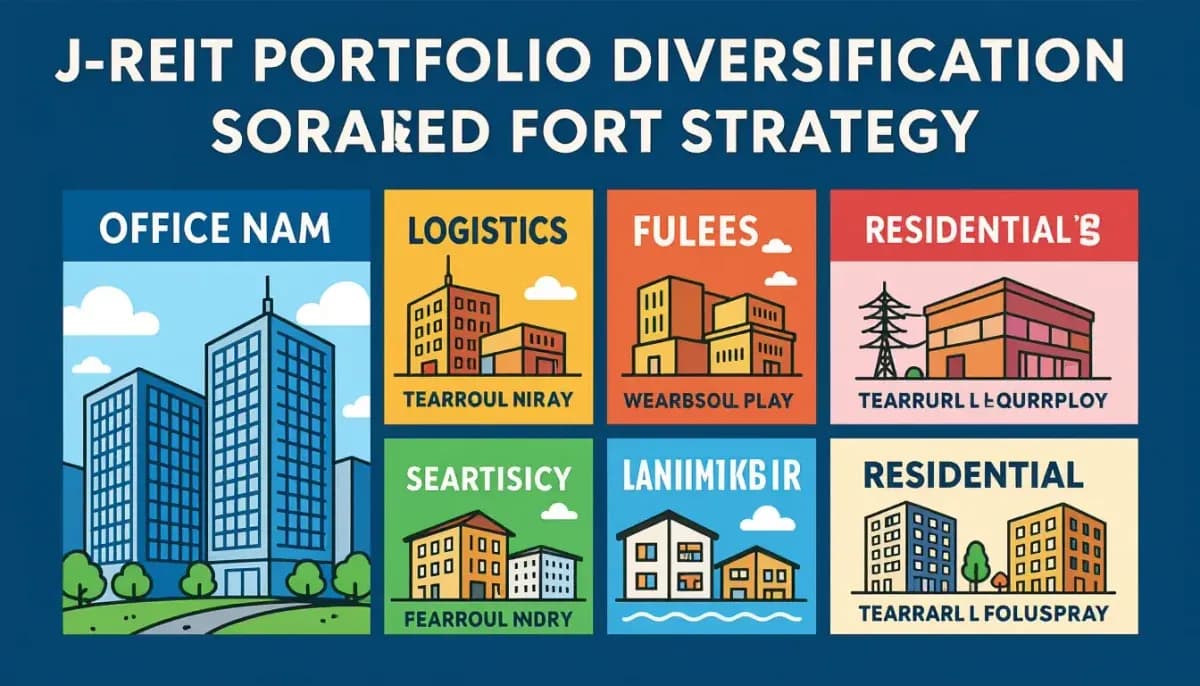
Learn how to build a diversified J-REIT portfolio as a foreign investor in Japan. Covers sector allocation, ETF strategies, interest rate risk, tax efficiency, and sample portfolios with real yield data.
Building a J-REIT Portfolio: Diversification Strategy Guide
Japan's real estate investment trust market offers foreigners one of the most accessible and professionally managed pathways into Japanese property. With 58 listed J-REITs on the Tokyo Stock Exchange commanding a market capitalization of approximately JPY 15–17 trillion, the sector provides meaningful exposure to premium commercial and residential assets across the country — all without the complexity of direct property ownership.
But simply buying one or two J-REITs is not a strategy. Building a genuinely diversified portfolio requires understanding sector dynamics, geographic concentration risk, interest rate sensitivity, and the interplay between yield and growth. This guide walks you through a systematic approach to constructing a J-REIT portfolio that balances income, capital preservation, and long-term appreciation.
Understanding the J-REIT Landscape
Before building a portfolio, you need to understand what you are working with. J-REITs must distribute over 90% of their taxable income to unitholders as dividends, which means they function largely as income-generating vehicles rather than growth stocks. The average dividend yield across the sector stood at approximately 4.56% as of late 2025 — well above Japanese government bond yields and comparable to many blue-chip equity dividend strategies.
The market is divided into six main property sectors:
| Sector | Typical Characteristics | Yield Range | Risk Profile |
|---|---|---|---|
| Office | Stable long-term leases, Tokyo-centric | 3.5–4.5% | Medium |
| Logistics/Warehouse | E-commerce driven demand, high supply | 3.8–5.0% | Medium-High |
| Residential | Low volatility, steady occupancy | 3.0–4.0% | Low-Medium |
| Retail | Shopping centers, tourist areas | 4.0–5.5% | Medium-High |
| Hotel/Hospitality | Tourism recovery, cyclical | 3.5–6.0% | High |
| Healthcare | Aging population tailwind, long leases | 4.0–5.5% | Low-Medium |
Understanding these distinctions is the foundation of an effective diversification strategy. Each sector responds differently to economic cycles, interest rate changes, and demographic shifts.
Why Diversification Matters for J-REIT Investors
The J-REIT index reached a peak in the second quarter of 2021, then declined approximately 16% through early 2024 before recovering. Investors concentrated in a single sector felt this volatility acutely — particularly those overweight in office REITs facing post-pandemic workspace challenges, or logistics REITs grappling with an oversupply wave.
A well-diversified portfolio smooths these sector-specific cycles. When office demand softens due to remote work trends, logistics and residential REITs tend to maintain their income streams. When tourism rebounds strongly, hospitality REITs outperform. Healthcare REITs, backed by Japan's rapidly aging population, provide structural support regardless of economic conditions.
For deeper context on how different J-REIT types compare, see our sector comparison and analysis guide, which covers the specific characteristics of each category in greater detail.
Step 1 — Define Your Portfolio Objectives
The right diversification strategy depends entirely on your investment goals. Ask yourself three questions before allocating capital:
Income vs. Growth: Are you primarily seeking dividend income, or do you want capital appreciation alongside income? Higher-yielding sectors like hotels and retail tend to offer less capital stability. Lower-yielding sectors like residential often provide more consistent unit price performance.
Time Horizon: Short-term investors need more liquid, stable REITs. Long-term investors can tolerate sector volatility and benefit from healthcare and logistics structural trends over a 10–15 year period.
Currency Exposure: As a foreign investor, all your J-REIT returns are denominated in yen. If the yen weakens, your returns in your home currency shrink even if the REIT performs well. Factor currency strategy into your allocation — some investors hedge partially or reduce total J-REIT exposure to manage this risk.
Our guide on J-REIT dividend yield analysis for foreign investors provides detailed benchmarks to help you calibrate income expectations against these trade-offs.
Step 2 — Sector Allocation Framework
A commonly recommended starting framework for a balanced J-REIT portfolio is the following:
| Sector | Suggested Allocation | Rationale |
|---|---|---|
| Office | 20–25% | Core stable income from Grade A Tokyo properties |
| Residential | 20–25% | Defensive holding with low vacancy volatility |
| Logistics | 15–20% | Long-term e-commerce and supply chain demand |
| Healthcare | 10–15% | Aging population structural growth story |
| Retail | 10–15% | Recovery potential from post-pandemic normalization |
| Hotel/Hospitality | 5–10% | Higher risk-reward, tourism recovery upside |
This is not a rigid formula. Investors with higher risk tolerance might weight hospitality more heavily during a strong tourism cycle. Conservative income-seekers might increase residential and healthcare at the expense of retail and hotels.
Tokyo office vacancy fell below 6% for the first time in three years in 2025, driven partly by aggressive expansion from foreign companies and tech firms. This signals improving fundamentals for office-focused REITs after a difficult few years. Meanwhile, the logistics sector faces short-term headwinds from elevated supply — new multi-tenant warehouse space in Greater Tokyo is projected at roughly 1.9 million square meters through 2025, keeping vacancy elevated — making selective stock picking important within that sector.
Step 3 — Geographic Diversification Within Japan
Beyond sector diversification, geographic concentration is a real risk. The majority of J-REIT assets are concentrated in central Tokyo (the three central wards of Chiyoda, Chuo, and Minato for office; Shibuya and Shinjuku for mixed-use). While Tokyo assets are high quality and liquid, over-concentration in a single metropolitan area amplifies exposure to local market conditions.
Look for J-REITs with meaningful allocations to:
- Osaka/Kansai — Japan's second-largest economy with strong logistics and retail demand
- Fukuoka — Fast-growing western Japan hub with tightening residential markets
- Nagoya/Chubu — Manufacturing-adjacent logistics and residential demand
Diversified J-REITs (those holding multiple property types across multiple regions) can provide built-in geographic spreading within a single investment vehicle. Some investors prefer these as core holdings, supplemented by focused sector REITs for targeted exposure.
For a broader view of Japan's regional real estate dynamics, resources like Living in Nihon offer useful context on living conditions and local market characteristics across different regions.
Step 4 — Using ETFs for Efficient Diversification
For investors who prefer passive exposure or are building a smaller portfolio, J-REIT ETFs provide instant diversification at low cost. Several Tokyo Stock Exchange-listed ETFs track the TSE REIT Index or sector-specific sub-indices, including:
- 1343 (Nomura J-REIT ETF) — Broad market index tracking
- 1597 (MAXIS J-REIT ETF) — Broad TSE REIT index
- 2515 (NEXT FUNDS REIT ETF) — Comprehensive market exposure
ETFs eliminate the need to analyze individual REITs, handle dividend reinvestment more efficiently in some structures, and can be purchased through the same brokerage account used for stock trading. The trade-off is that you cannot customize sector weights — you take the market allocation as-is.
A hybrid approach works well for many investors: use a broad J-REIT ETF as the core (60–70% of your J-REIT allocation), then add individual sector REITs for targeted overweights or underweights relative to the index.
For guidance on the practical mechanics of purchasing J-REIT shares from abroad, see our step-by-step guide to buying J-REIT shares as a foreign investor.
Step 5 — Managing Interest Rate and Currency Risk
J-REITs are particularly sensitive to interest rate changes because they borrow heavily to finance property acquisitions and because rising rates make their dividend yields less attractive relative to bonds. The Bank of Japan's gradual exit from ultra-loose monetary policy in 2024–2025 created headwinds for the sector broadly.
Strategies to manage this risk in a portfolio context:
Floating vs. Fixed Rate Debt: Favor J-REITs with higher proportions of fixed-rate debt. These are less exposed to rising borrowing costs over the short to medium term.
Loan-to-Value Ratios: J-REITs with LTV ratios below 40% are generally more resilient to rate rises and property devaluations. Monitor LTV as a portfolio health indicator.
Currency Hedging: Foreign investors should consider whether to hedge yen exposure. Hedging is not free — currency swap costs fluctuate — but during periods of yen weakness it can be worthwhile. For most long-term investors, accepting unhedged yen exposure and sizing the J-REIT portfolio appropriately relative to total assets is the simpler approach.
Our comprehensive article on J-REIT tax implications for foreign investors also covers withholding tax rates — approximately 20.42% on dividends, potentially reduced to 10–15% under applicable tax treaties — which directly affect your net yield calculations.
Step 6 — Portfolio Monitoring and Rebalancing
A J-REIT portfolio is not set-and-forget. Markets shift, sector fundamentals change, and your personal circumstances evolve. A practical monitoring regime includes:
- Quarterly review of each holding's occupancy rates, leasing activity, and debt metrics
- Annual rebalancing back toward target sector weights when drift exceeds 5 percentage points
- Distribution reinvestment decisions — whether to take dividends as cash or reinvest in additional units
- Manager quality assessment — J-REITs are externally managed, and the quality of the sponsor (e.g., Mitsubishi Estate, Mitsui Fudosan, Sumitomo Realty) materially affects long-term performance
For context on how J-REIT performance has evolved over the long run, our J-REIT market performance and historical returns analysis provides benchmarks against which to assess your portfolio results.
Tax Efficiency Considerations for Foreign Investors
Foreign investors in J-REITs face a layered tax structure. Dividend income is subject to Japanese withholding tax before distribution, and may then be taxable in your home country depending on local rules and the applicable tax treaty. Capital gains on unit sales are subject to Japanese tax at 20.315% if you hold through a Japanese brokerage account.
Key tactics for tax efficiency:
- Check your country's tax treaty with Japan — Many reduce withholding on REIT dividends to 10–15%
- Use NISA accounts if eligible — Japan's tax-free investment account (NISA) can shelter J-REIT dividends and gains if you are a Japanese tax resident
- Document all transactions carefully — Currency conversion records are essential for calculating home-country taxable gains accurately
For comprehensive guidance on the financial and legal aspects of real estate investment in Japan, sites like Gaijin Buy House and For Work in Japan offer practical frameworks for foreigners navigating the Japanese financial system.
Sample Portfolio Constructions
Conservative Portfolio (¥3 million allocation)
| Holding | Type | Allocation | Rationale |
|---|---|---|---|
| J-REIT ETF (1343) | Broad Index | 50% | Diversified core exposure |
| Nippon Prologis REIT | Logistics | 20% | Premium logistics sponsor quality |
| Advance Residence Investment | Residential | 20% | Defensive urban residential |
| Healthcare & Medical REIT | Healthcare | 10% | Aging Japan structural growth |
Growth-Oriented Portfolio (¥10 million allocation)
| Holding | Type | Allocation | Rationale |
|---|---|---|---|
| J-REIT ETF | Broad Index | 30% | Market beta core |
| Nippon Building Fund | Office | 20% | Premium Tokyo Grade A office |
| GLP J-REIT | Logistics | 20% | E-commerce infrastructure |
| Japan Hotel REIT | Hotel | 15% | Tourism recovery upside |
| Healthcare & Medical | Healthcare | 15% | Structural demographic trend |
For guidance on comparing J-REITs against direct property ownership in Japan, our detailed J-REIT vs direct property investment analysis quantifies the trade-offs across liquidity, control, leverage, and total return.
Conclusion
Building an effective J-REIT portfolio is not about maximizing yield at any cost — it is about constructing a resilient income-generating allocation that withstands sector cycles, rate movements, and currency volatility. Start with a clear objective, allocate across at least four of the six main sectors, use ETFs for broad exposure when appropriate, and monitor underlying fundamentals rather than just unit prices.
The J-REIT market offers foreign investors a genuinely rare combination: professional management, high income distribution, Tokyo Stock Exchange liquidity, and access to some of Japan's finest commercial and residential properties. A well-constructed diversified portfolio can capture these advantages while managing the risks that come with any concentrated single-country, single-asset-class investment.
For a complete overview of indirect real estate investment options in Japan, including structures beyond J-REITs, start with our pillar guide on J-REITs and indirect real estate investment in Japan.
Sources:

Originally from Vietnam, living in Japan for 16+ years. Graduated from Nagoya University, with 11 years of professional experience at Japanese and international companies. Sharing information about buying property in Japan for foreigners.
View Profile →Related Articles
Japan Real Estate Securitization Explained for Investors
Understand Japan's real estate securitization market — J-REITs, TMK, and GK-TK structures explained. A complete guide for foreign investors with tax implications, market trends, and how to get started.
Read more →
J-REIT Market Performance and Historical Returns Analysis
Comprehensive analysis of J-REIT market performance and historical returns for foreign investors. Learn about dividend yields averaging 4.61%, how to invest as a foreigner, tax considerations, and sector breakdowns across Japan's ¥16 trillion REIT market.
Read more →
Private REITs and Institutional Real Estate Investment in Japan
Comprehensive guide to private REITs and institutional real estate investment in Japan. Learn how private J-REITs work, who can access them, market trends, and how foreigners can invest in Japan's property market through REITs and direct ownership.
Read more →
J-REIT Tax Implications for Foreign Investors
Complete guide to J-REIT tax implications for foreign investors: withholding tax rates (20.42%), treaty reductions, capital gains rules, double taxation relief, and filing requirements explained.
Read more →
Japan Real Estate Crowdfunding Platforms: Complete Guide
Complete guide to Japan real estate crowdfunding platforms for foreign investors. Compare CREAL, OwnersBook, Minna De Ooyasan and learn how foreigners can invest with as little as ¥10,000.
Read more →
Japan Real Estate Investment Funds: Options Beyond REITs
Discover Japan real estate investment fund options beyond J-REITs: GK-TK structures, private REITs, crowdfunding platforms like COZUCHI, and more for foreign investors.
Read more →